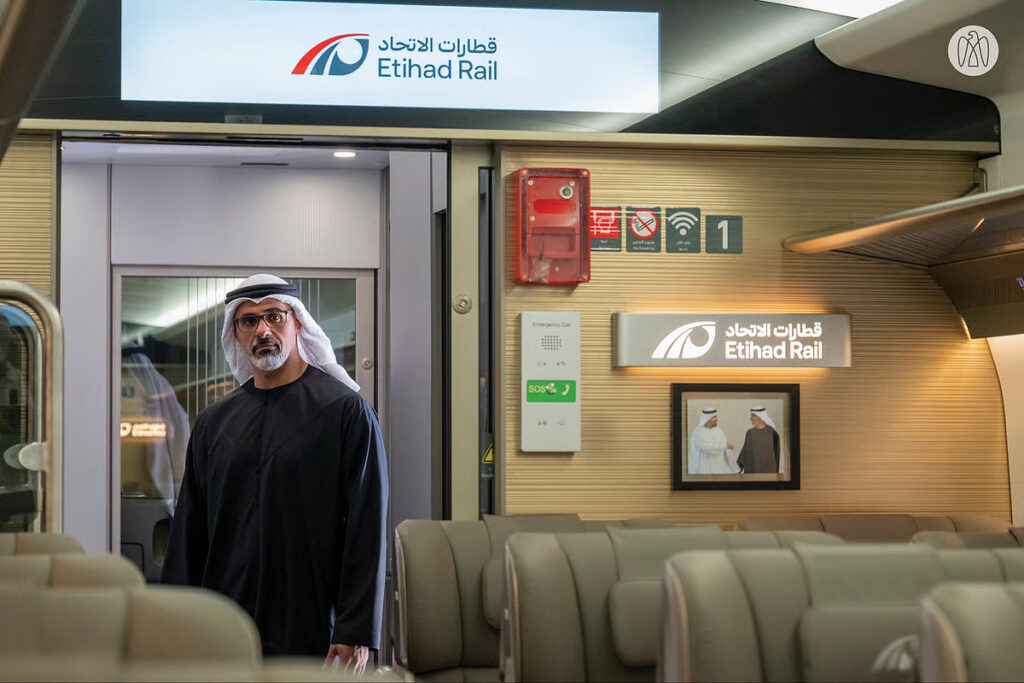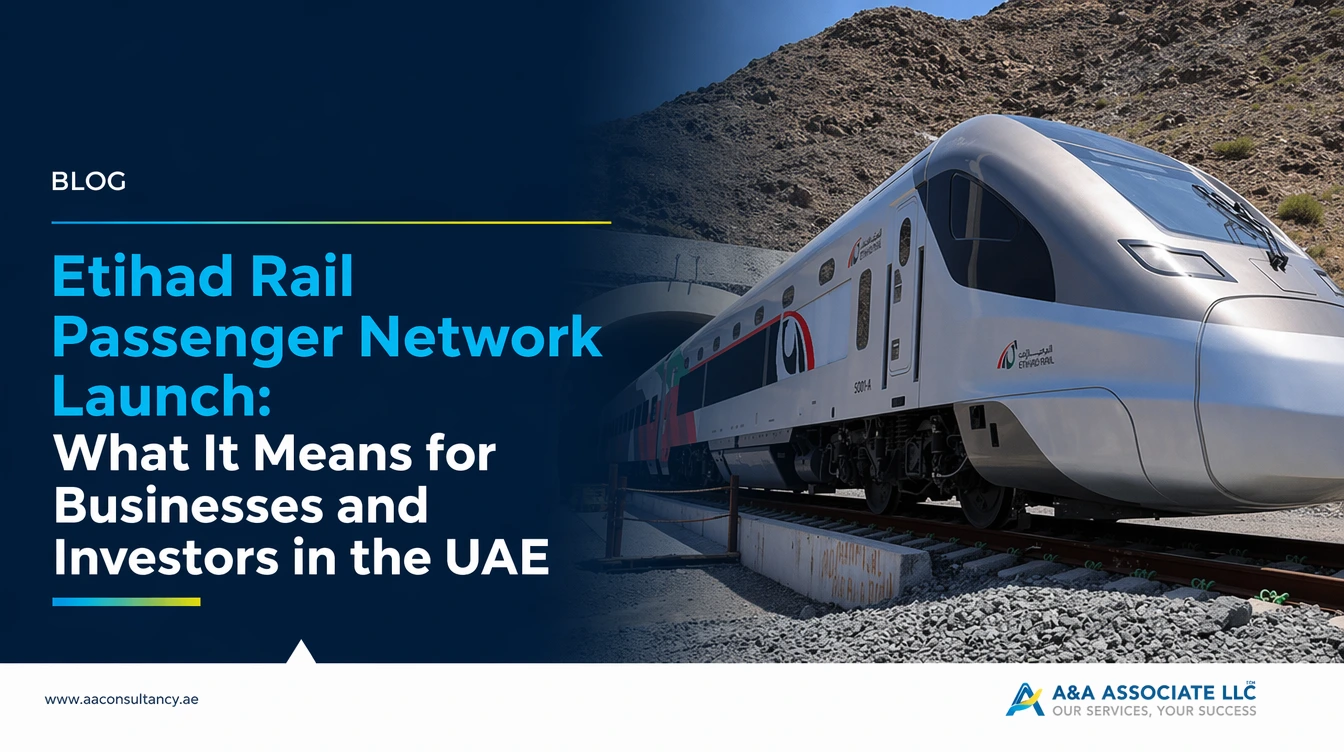
On 30 June 2026, the UAE starts something it has been building towards for years. Etihad Rail opens its first passenger service, running between Abu Dhabi and Fujairah. It is the introductory phase of a national network that, once complete, will link 11 cities and regions across the country.
For most people, the headline is the train ride. Abu Dhabi to Dubai in 57 minutes. Abu Dhabi to Fujairah in 1 hour and 45 minutes. That alone changes how people move around the UAE.
But the Etihad Rail launch is about more than getting from A to B faster. When you connect a country's cities with fast, reliable rail, you change where businesses can operate, where people can live and work, and where investment flows. That is the part worth thinking about if you run a company or are weighing up business setup in the UAE.
This article looks at the launch through a business lens. What is opening and when, how connectivity reshapes opportunity, and where the openings sit for entrepreneurs, SMEs, and investors. The figures here come from Etihad Rail's official announcements, though routes, fares, and schedules can change, so always check the latest before you plan around them.
Etihad Rail passenger network officially begins in 2026
The rollout is phased, not all at once. That matters for planning, because each phase opens up a new part of the map.
The introductory phase starts on 30 June 2026, running between Abu Dhabi and Fujairah. The official public launch follows on 30 September 2026, when the Dubai and Al Dhaid stations open. Stations across the Al Dhafra region open on 30 December 2026. The network is complete on 30 March 2027, when Sharjah's station opens.
So within nine months, the UAE moves from a single intercity line to a connected national passenger railway. Booking opened on the Etihad Rail app and website on 23 June 2026, ahead of the first journeys.
If you are planning a regional move or expansion, those dates are worth marking. The map you are setting up in will look different in March 2027 from how it looks today.
Key facts about the Etihad Rail passenger service
Here are the core details in one place.
| Detail | Information |
|---|---|
| Introductory phase launch | 30 June 2026 (Abu Dhabi–Fujairah) |
| Official public launch | 30 September 2026 (Dubai and Al Dhaid stations) |
| Al Dhafra stations open | 30 December 2026 |
| Network complete | 30 March 2027 (Sharjah station) |
| Cities and regions connected | 11, across the full network |
| Fleet | 13 trains, up to 400 passengers each |
| Top speed | 200 km/h |
| Abu Dhabi–Fujairah journey | 1 hour 45 minutes |
| Abu Dhabi–Dubai journey | 57 minutes |
| Fares (Abu Dhabi–Fujairah) | From Dh55 Comfort Class; Dh120 Premium Class |
| Booking | Etihad Rail app and website |
The full network will connect Abu Dhabi, Dubai, Sharjah, Fujairah, Al Dhaid, Al Dhannah, Al Faya, Madinat Zayed, Mezaira'a, Al Mirfa, and Al Sila. That spread reaches well beyond the main cities into regions that have not had this kind of connectivity before.
What is Etihad Rail and why is it important?
Etihad Rail is the UAE's national railway. The network spans more than 900 km and already runs freight across the country. The passenger service launching in 2026 is the next stage, opening the same backbone to people, not just cargo.
This is national infrastructure with a long horizon. It links the seven emirates, supports the movement of goods and workers, and gives the UAE a transport spine that does not depend on roads and cars alone.
The economic logic is straightforward. When you cut the time and cost of moving people and goods between cities, you widen the area in which a business can realistically operate. A company in Abu Dhabi can serve clients in Fujairah without losing a day to driving. A worker can live in one emirate and work in another. Markets that felt separate start to behave like one.
How Etihad Rail will improve connectivity across the UAE
The clearest change is time. Driving from Abu Dhabi to Fujairah can take well over two hours, often more in traffic. The train does it in 1 hour and 45 minutes, with no traffic and no parking. Abu Dhabi to Dubai drops to 57 minutes.
For a business, saved time is saved money. A sales team can cover more ground. A consultant can take a morning meeting in one emirate and an afternoon meeting in another. Goods and people move on a predictable schedule rather than at the mercy of the motorway.
Accessibility improves too. The network reaches regions like Al Dhafra and towns such as Madinat Zayed and Al Mirfa that have been harder to reach. For businesses, that means new catchment areas. For residents in those regions, it means access to jobs and services in the bigger cities.
Connectivity is rarely a headline, but it quietly decides where business can happen. Faster links between emirates effectively enlarge the market every UAE company can reach.
How Etihad Rail could impact business growth
Better connectivity tends to show up in four practical ways for businesses.
Employee Mobility
When staff can commute between emirates in under an hour, your hiring pool widens. You are no longer limited to people who live near the office, which helps with both recruitment and retention.
Expansion Gets Cheaper
Opening a second location in another emirate is less daunting when your team can reach it by train in under two hours. The friction of running a multi-city operation drops.
Market Access Grows
A business in Dubai can serve customers in Sharjah or Fujairah more easily, and the reverse holds too. Smaller cities gain access to bigger markets, and bigger cities reach new customers.
Regional Operations
Companies with sites in several emirates can move people and small goods between them on a reliable timetable, which makes coordination simpler and planning more predictable.
If you are thinking about a multi-emirate structure, our guide to company formation in the UAE covers how mainland and free zone options work across the country.
Opportunities for entrepreneurs and SMEs
Big infrastructure usually helps small businesses more than people expect.
- 🛍️ New customer markets open up. A bakery, agency, or service firm that once served one city can reach customers in connected towns it could not practically serve before.
- 📦 Regional expansion becomes realistic for smaller players. You no longer need a big logistics budget to operate across emirates. The rail line lowers the barrier that used to keep expansion to large companies.
- 💰 Transport costs fall. For people-heavy businesses, especially services, cheaper and faster staff travel is a real saving. Fares starting at Dh55 for the Abu Dhabi–Fujairah route make regular intercity travel affordable.
- 🏨 Tourism-driven demand grows. Stations are being designed as lifestyle hubs, with cafés, restaurants, and retail. More visitors moving between emirates means more footfall for hospitality, retail, and leisure businesses near stations and along routes.
For a founder, the practical message is simple. The rail network turns several separate local markets into one larger connected one, and that is exactly the kind of shift that creates room for new businesses.
How Etihad Rail could influence real estate and commercial development
Rail changes property. It always has, in every country that has built it. The UAE will be no different.
- 🏗️ Transit-oriented development is the pattern to watch. Areas around stations tend to attract offices, shops, hotels, and homes, because access drives value. Land near a station becomes more useful, and more valuable.
- 🏢 New commercial hubs can form. A station gives a town a reason to build a business district around it. Towns that were quieter may see fresh commercial activity as they become easier to reach.
- 🛒 Retail follows the footfall. Stations designed as lifestyle hubs, plus the people passing through them, create demand for shops, food, and services in and around them.
- 📍 Emerging business districts become more viable. Locations that were previously too far from the action can become practical bases once they sit on a fast rail line. That can shift where companies choose to set up.
For investors and business owners, the takeaway is to think about location with the 2027 map in mind, not just today's roads.
Economic impact of the UAE passenger rail network
Big infrastructure tends to lift the wider economy, though the effects build over years rather than overnight.
The construction and operation of a national railway supports jobs directly, from station staff to maintenance and operations, and indirectly through the suppliers and services around it.
It also makes the UAE more attractive to investors. A connected, modern transport network is exactly the kind of infrastructure international companies look for when choosing where to base regional operations. It signals a country investing in its own long-term competitiveness.
Then there is the productivity effect. When people and goods move faster and more cheaply, businesses get more done for the same cost. Economists call this infrastructure-led growth, and it is one reason governments invest so heavily in rail.
It would be wrong to attach a precise figure to all of this, since the full impact will unfold over years. But the direction is clear. Better connectivity supports a larger, more productive, more investable economy.
What Etihad Rail means for foreign investors
If you are based abroad and looking at the UAE, the rail launch strengthens an already strong case.
The business environment improves
A national railway adds to the infrastructure that makes the UAE easy to operate in, alongside its airports, ports, and digital networks.
Regional reach expands
From a single UAE base, you can serve a more connected national market, which makes the country an even better springboard for the wider Gulf region.
Investor confidence grows
Governments that deliver large infrastructure on a clear timeline signal stability and long-term planning, which is what cross-border investors want to see before committing.
Market access gets simpler
Reaching customers and partners across the emirates becomes more practical, which lowers the cost of building a national presence.
Entering a new market still needs the right structure and proper compliance. That is where local guidance earns its place, and where our business advisory services help you start on solid ground.
Business setup opportunities along the Etihad Rail network
Different stops on the network suit different kinds of business. The table below is a starting map, not a guarantee, since the best fit depends on your activity, capital, and goals.
| Location | Business Opportunity | Growth Potential |
|---|---|---|
| Abu Dhabi | HQ, finance, industry, government-linked services | High |
| Dubai | Trade, tech, tourism, professional services | High |
| Sharjah | Manufacturing, logistics, education, SMEs | High |
| Fujairah | Ports, logistics, tourism, hospitality | Growing |
| Al Dhaid | Agriculture, retail, services for a connected town | Emerging |
| Al Dhafra | Industry, energy, logistics support | Emerging |
| Madinat Zayed / Al Mirfa | Regional services, hospitality, retail | Emerging |
The pattern to notice is the emerging locations. As the network connects smaller towns and regions, businesses that set up early can establish a presence before competition arrives. Whether mainland or free zone suits you depends on your plans, and our free zone company setup and mainland company formation options each have their place.
Future outlook for UAE infrastructure and economic development
The rail launch fits a bigger picture. The UAE has spent years building infrastructure that supports a diversified, future-focused economy, and Etihad Rail is a major piece of that.
Smart Mobility
A modern railway connects with the country's wider push towards efficient, technology-led transport and a smarter national infrastructure.
Sustainability
Rail moves large numbers of people with far lower emissions per passenger than cars, which supports the UAE's Net Zero 2050 environmental goals.
Long-Term Investment Outlook
Infrastructure like this is built for decades, giving businesses and investors confidence that the connectivity they plan around today will still be there well into the future.
For anyone making a long-term bet on the UAE, that durability is part of the appeal.
Your Business Setup Partner
How A&A Associate LLC can help
A&A Associate LLC is a Dubai-based advisory firm that helps entrepreneurs and companies set up and run compliant businesses across the UAE. We are not a transport or government body. What we do is handle the practical side of establishing and growing a business in this changing market.
As the rail network opens up new locations and markets, the businesses that benefit most will be the ones that set up correctly and stay compliant from the start. That is the part we handle, so you can focus on the opportunity.