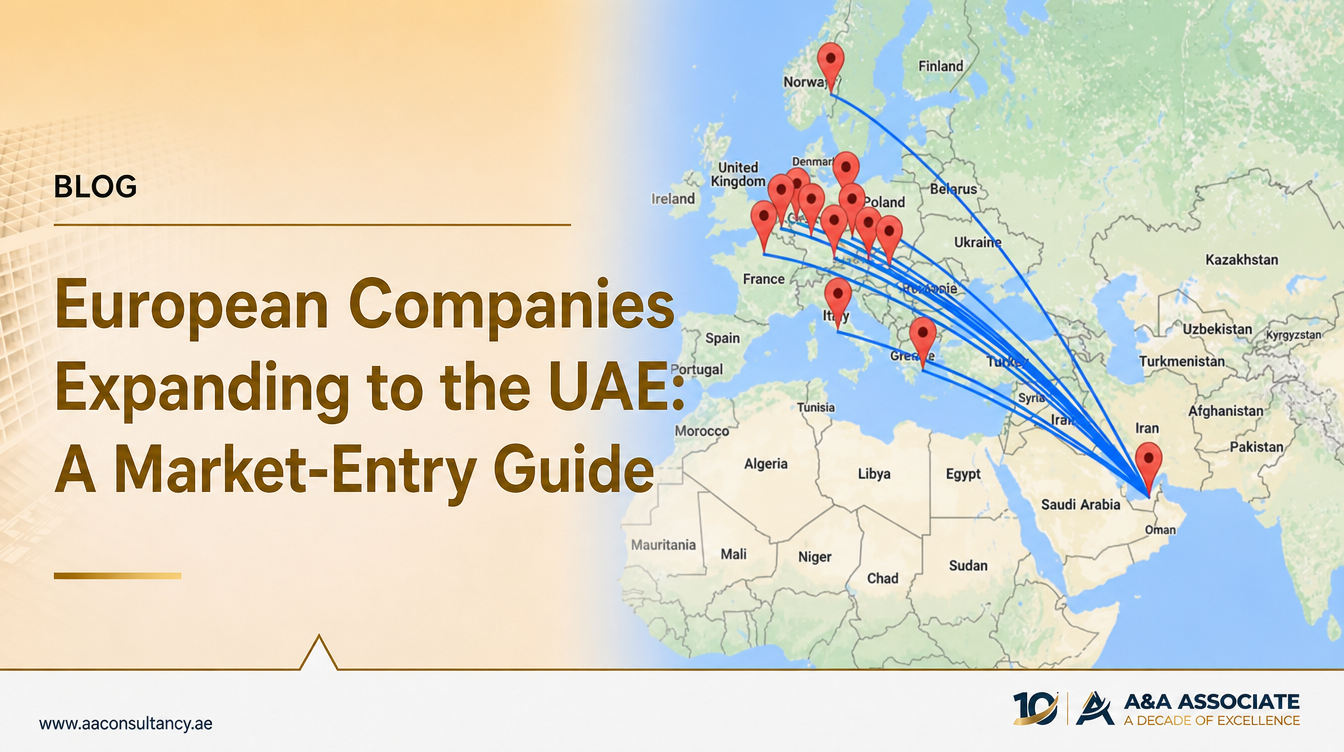
Interest from European companies in the UAE has moved well past curiosity. Trade missions run in both directions, European chambers of commerce in Dubai keep growing their memberships, and conversations that used to start with "should we look at the Gulf?" now start with "how should we structure it?"
That shift in the question matters, because for most European businesses the UAE isn't just another export market. It can be a regional headquarters covering the Gulf and beyond, a distribution hub sitting between European suppliers and Middle Eastern, African and South Asian customers, a trading base, or the platform for a wider Middle East expansion. Which of those it becomes depends on decisions made before anyone fills in a registration form.
A German machinery maker serving Saudi customers, a French consultancy advising Gulf governments, and a Dutch trader re-exporting to East Africa are all "expanding to the UAE," and the right structure is different for each of them. Before anything gets registered, a European business needs a view on branch versus subsidiary, mainland versus free zone, the tax and treaty position between the UAE and its home country, its operational requirements, and where the expansion is meant to be in five years. This article walks through each of those in turn.

Why Are European Companies Expanding to the UAE?
The reasons are practical rather than exotic.
Geography does a lot of the work. The UAE sits between European time zones and Asian ones, with the Middle East and Africa on its doorstep. A Milan-based manager can hold morning calls with the Dubai office and afternoon calls with customers in Riyadh or Nairobi without anyone losing a working day.
The business environment is deliberately international. English is the working language of commerce, the professional-services ecosystem (law, audit, banking) is familiar to anyone who has worked in London or Frankfurt, and European companies find themselves alongside thousands of their peers rather than pioneering alone.
For many, the UAE is less a destination than a base. Gulf markets, particularly Saudi Arabia, are investing heavily; African consumer markets are growing; South Asia is next door. Serving those markets from Amsterdam involves long flights and awkward hours. Serving them from Dubai or Abu Dhabi is a regional operation.
Infrastructure supports the model: two of the world's major airlines and their hubs, some of the region's largest ports, modern digital infrastructure, and logistics ecosystems built around re-export. And sector momentum is broad, spanning technology, manufacturing, logistics, renewable energy, professional services, healthcare and financial services, with government strategies actively courting each.
None of this makes the UAE automatic. It makes it a serious candidate, which is exactly why the structural questions deserve serious answers.
The First Decision: Branch or Subsidiary?
When a European company decides to establish a presence, the foundational choice is between operating as a branch of the European parent or creating a UAE subsidiary. They look similar from the outside (an office, a licence, staff) and behave differently in almost every way that matters.
What is a UAE branch of a European company?
A branch is generally an extension of the parent company rather than a new company. The European entity itself is registered to operate in the UAE; there's no separate shareholding, because there's no separate company. The branch conducts business in the parent's name, and its activities are tied to what the parent does.
Branches tend to suit companies extending existing operations into the UAE: carrying out contracts, servicing regional clients, or establishing a presence that is deliberately and permanently part of the parent. The regulatory side has its own requirements, including registration formalities for foreign companies and, in some cases, activity restrictions, so the option needs checking against your specific business rather than assuming availability.
What is a UAE subsidiary?
A subsidiary is a separate legal entity incorporated in the UAE, typically owned by the European parent. It has its own legal identity, its own licence in its own name, and a corporate existence distinct from the parent.
That separation is the point. A subsidiary can develop its own contracts, build a local identity, take on activities that differ from the parent's, and grow into a genuine regional business rather than an outpost. For companies planning long-term UAE operations, local hiring at scale, or eventual regional expansion with the UAE entity as the hub, the subsidiary is usually the structure under discussion.
Branch vs subsidiary: which is better?
Neither, in the abstract, and be wary of anyone who answers without asking about your business first.
| Consideration | Branch | Subsidiary |
|---|---|---|
| Legal relationship | Extension of parent company | Separate legal entity |
| Independence | Lower | Higher |
| Suitable for | Extending parent operations | Long-term local operations |
| Structure | Parent-linked | Separate UAE entity |
| Best for | Depends on business model | Depends on business model |
The honest answer runs through five questions. What are the commercial plans: extending what the parent already does, or building something with its own life? What is the business activity, and how do the licensing rules treat it in each form? How should risk sit between the UAE operation and the parent? What does each structure mean for the tax position, in the UAE and at home? And where does the expansion strategy point: if the UAE entity might one day hold other regional operations, that argues for structural independence from day one.
Companies frequently default to whichever structure their last international expansion used. The UAE's rules, and its tax regime, are their own; the default deserves re-examination here.
How Double Tax Treaties Matter to European Companies
A Double Taxation Agreement (DTA) is a bilateral treaty between two countries designed to address situations where the same income could have tax implications in both jurisdictions, and to provide rules for which country taxes what. The UAE has built an extensive network of such agreements, including treaties with most European countries; the UAE Ministry of Finance maintains the official list.
For a European company, the treaty with its home country forms part of the market-entry analysis, not an afterthought. But treat DTAs with respect rather than enthusiasm: a treaty does not automatically eliminate tax, and a European company does not automatically receive benefits by virtue of existing. What a treaty actually delivers depends on the specific treaty's terms, the type of income involved (business profits, dividends, royalties, and so on are treated differently), the company's structure, where the relevant entities are tax resident, and how the treaty interacts with current UAE tax legislation.
A concrete way to think about it: a European manufacturer sets up a UAE subsidiary that earns profits and eventually pays dividends to the parent. How those profits are taxed in the UAE, how the dividends are treated when they arrive in Europe, and what the treaty says about each step is a chain of questions spanning two tax systems and one treaty. The answers differ between a parent in Germany, one in France, and one in the Netherlands, because the treaties and home-country rules differ. This is precisely the analysis to commission before choosing a structure, since the structure is one of the variables that determines the outcome.
Free Zone or Mainland? Choosing the Right UAE Market-Entry Location
The second structural axis is where the entity sits: in one of the UAE's many free zones, or on the mainland. The right answer follows the business model, not the price list.
When might a free zone be suitable?
Free zones tend to fit European companies whose UAE operation faces outward. Sector-specific zones offer ecosystems where a technology company, media business, or commodities trader sits among its industry, with licensing built for its activities. International trading structures, buying from one country, selling to another, with the UAE as the pivot, are what many zones were designed around. Regional headquarters planning often lands in free zones with strong corporate infrastructure. And logistics and distribution businesses gravitate to zones adjacent to ports and airports, where warehousing and customs processes are part of the offer.
When might mainland be more suitable?
The mainland comes into focus when the UAE domestic market is the target. Companies that need to sell directly across the UAE, contract with government entities, open customer-facing locations, or conduct activities that licensing rules place onshore will find the mainland the natural home. It also offers the widest operational flexibility for businesses whose plans don't fit neatly into a single zone's scope.
How Should European Companies Choose the Right UAE Free Zone?
There are dozens of free zones, and there is no single best one for European companies, whatever any zone's marketing says. What exists is a best fit for a specific business, found by working through a consistent set of questions:
- Your exact business activity, and which zones license it well
- Who your target customers are and where they sit
- Whether operations are UAE-facing, international, or both
- Location and logistics needs, especially port or airport adjacency
- Office and facility requirements, from a desk to a warehouse
- Employee numbers and visa needs, which zones accommodate differently
- Banking and operational practicalities
- Long-term expansion plans, including whether the entity will hold other investments
- The applicable tax considerations for your structure
- Any sector-specific regulatory requirements
Worked honestly, that list usually narrows dozens of options to two or three, and the final choice becomes a comparison rather than a guess. The cheapest licence is not always the most suitable market-entry structure, and the difference between the two tends to surface at the worst time, when a bank, a customer, or a tax filing exposes it.
UAE Corporate Tax and European Companies: What Should Businesses Consider?
The UAE introduced federal Corporate Tax for financial years starting on or after 1 June 2023, and European companies should place it inside their market-entry planning rather than after it. The Federal Tax Authority publishes the governing guidance.
A few principles keep the planning honest. The legal structure alone does not determine the tax outcome; the authorities look at commercial substance and what the business actually does, not just what its documents say. Free zone entities should review the qualifying conditions attached to any preferential treatment carefully, because those conditions concern the nature of income and the substance behind it, and they are tested continuously rather than granted once. And the UAE position is only half the picture: a European parent's home-country rules (on foreign profits, controlled companies, and repatriation) interact with the UAE rules, and the combined effect is what the CFO actually cares about.
None of this is individual tax advice, and no two European companies will land in exactly the same position. The practical takeaway is sequencing: obtain professional tax advice on your specific structure while it's still a proposal, when changing it costs nothing.
A Practical UAE Market-Entry Roadmap for European Companies
- Define the UAE business objective Sales into the region, distribution, a regional headquarters, manufacturing, services delivery, or investment holding. Every subsequent decision keys off this, which is why "we'll decide later" is the most expensive answer.
- Select the business structure Branch or subsidiary, tested against the five questions above rather than habit.
- Review the target market Establish whether the business needs direct UAE market access or is using the UAE as a platform for markets beyond it.
- Compare mainland and free zone options Match the shortlist to the activity, customers, and logistics, not to the price list.
- Review tax and treaty considerations UAE Corporate Tax, the relevant bilateral treaty, and the home-country position, analysed together.
- Plan operational requirements Office or warehouse, visa numbers, banking (allow real time for onboarding), staffing, and licensing details.
- Establish the UAE entity With the structure settled, the formation itself is the mechanical part. Experienced business setup consultants coordinate the registration, approvals, and the operational pieces around it, and the earlier steps are where advisers who handle business setup in Dubai for international companies add the most value, precisely because they've watched other European entrants get the sequence right and wrong.
Post-entry, the entity needs running: accounting services aligned with UAE requirements, corporate tax services for registration and filings, and periodic structural reviews as the business grows. Building those into the plan from the start is cheaper than retrofitting them.
Common Mistakes European Companies Make When Entering the UAE
The recurring ones, from observation rather than theory: choosing a free zone on price alone and discovering the fit problem later. Defaulting to a branch because it feels simpler, without testing the subsidiary case. Assuming the UAE is completely tax-free, which it is not; the regime is real and substance-based. Ignoring the double tax treaty analysis until after the structure is fixed, when it should have informed the structure. Never defining the UAE objective precisely, so the structure serves no strategy. Selecting a business activity on the licence that doesn't match what the company actually does, which surfaces at banking and renewal. Treating the entity as a registration exercise rather than a market entry, no local plan, no banking preparation, no operational thought. Ignoring where the business wants to be in five years. Working from information that predates the UAE's corporate tax era. And assuming that whatever structure worked for another European company will work for this one.
Most of these share a root cause: doing the paperwork before the thinking. The order should be the reverse, and for companies wanting a structured look at the options, >business advisory services exist for exactly this stage.
Frequently Asked Questions
Can a European company set up a business in the UAE?
Should a European company open a branch or subsidiary in the UAE?
What is the difference between a UAE branch and subsidiary?
Is a free zone suitable for European companies?
Should European companies choose mainland or free zone?
Do UAE double tax treaties apply to European companies?
Is the UAE tax-free for European companies?
What is the best UAE free zone for a European business?
How long does European company setup in the UAE take?
Can a European company use the UAE as a regional headquarters?
Does a European company need a local partner in the UAE?
Should European companies get tax advice before entering the UAE?
Conclusion
The UAE has earned its place on European expansion shortlists: the location, infrastructure, and regional access are real, and the UAE's official investment channels reflect how deliberately the country courts international business. What separates the European companies that thrive here from those that restructure expensively in year two is rarely the market. It's the entry: whether branch or subsidiary was chosen for reasons, whether the free zone fits the model, and whether the tax and treaty analysis happened before the structure was fixed.
Planning to expand from Europe to the UAE?
A&A Associate LLC can help you assess your business structure, market-entry objectives and suitable UAE setup options before you take the next step, which is exactly the order these decisions should happen in.
Discuss Your Market EntryThis article is for general informational purposes only and does not constitute legal or tax advice. UAE regulations, tax rules, and treaty positions depend on specific facts and change over time. Verify current requirements with the relevant UAE authorities and seek professional advice for your specific structure.