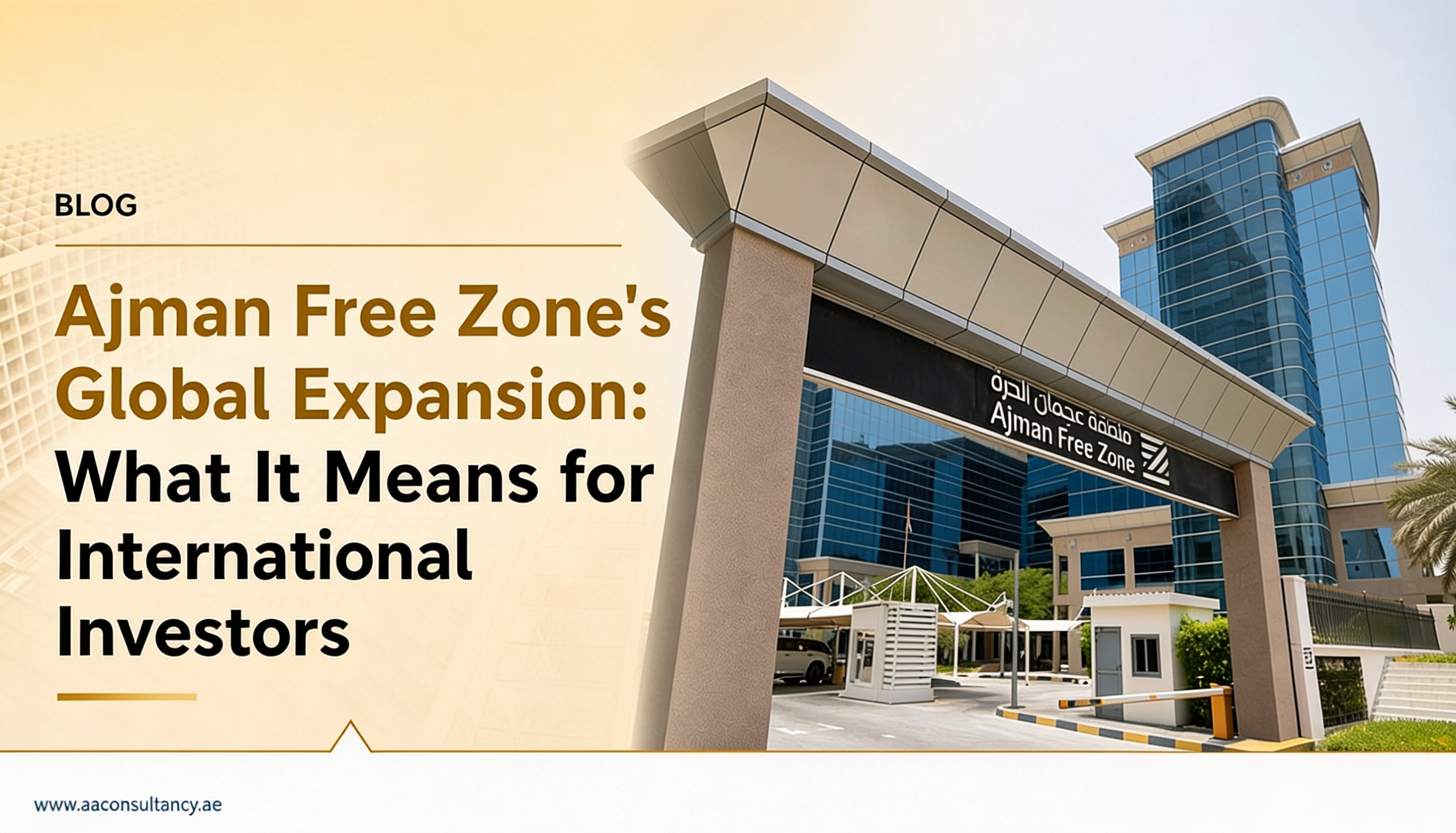
Ajman Free Zone is going abroad to bring investors home. Speaking at the RESET & RISE business forum in July 2026, Zubair Ul Islam, Director of Sales at Ajman Free Zone Authority, confirmed that the free zone has opened ten international offices in recent months and plans to double that number to twenty by next year. Three of those offices are already operating in India (Delhi, Kerala and Chennai), with further presence across China, Turkey, Russia, Egypt and Paris.
A free zone opening sales offices overseas is not, by itself, remarkable. What makes this worth a closer look is what it says about where foreign investment into the UAE is coming from, and who it's coming from. AFZ isn't chasing multinationals in London or Singapore. It's setting up shop in India's tier-2 and tier-3 cities and courting Chinese manufacturers, which tells you exactly where the next wave of UAE company formation is expected to originate: small and mid-sized businesses that have outgrown their home market and want a base with global reach.
This article unpacks what the expansion means in practice: why India and China matter so much, what free zones actually offer a foreign investor, where the manufacturing opportunity sits, and how to think about choosing a UAE jurisdiction if you're weighing a move.

Ajman Free Zone Expands Its Global Presence
The numbers behind the announcement are worth setting out plainly. Ajman Free Zone, established in 1988, now serves more than 20,000 companies from around 200 nationalities. The authority has opened ten overseas offices in recent months and intends to reach twenty by 2027. It licenses more than 3,000 business activities across trading, manufacturing, logistics, digital services, and professional sectors, and has recently expanded into family office structures, offshore entities, and specialised licensing.
The logic of the overseas offices is educational as much as commercial.
"Our aim is to be at their place, educate customers there and make their investment journey as easy as possible." Zubair Ul Islam, Director of Sales, Ajman Free Zone Authority — RESET & RISE forum, July 2026
In other words: rather than waiting for a business owner in Coimbatore or Chengdu to find the UAE, the free zone meets them at home, walks them through the options, and handles much of the groundwork before they ever board a flight.
That model matters most for the businesses AFZ is explicitly targeting: SMEs and manufacturers who don't have corporate development teams or international legal counsel. For a first-time cross-border investor, the difference between an accessible, well-explained process and an opaque one often decides whether the expansion happens at all.
Why India and China Remain Strategic Markets
The choice of markets is not accidental. India and the UAE signed a Comprehensive Economic Partnership Agreement (CEPA) in 2022, which cut tariffs across a wide range of goods and has pushed bilateral non-oil trade sharply upward since. India consistently ranks among the UAE's largest trading partners, and Indian nationals form one of the largest business communities in every UAE free zone. AFZ's decision to go beyond Mumbai and Delhi into tier-2 and tier-3 cities reflects something real: India's manufacturing and export base is increasingly distributed across smaller industrial cities, and those businesses are underserved by international expansion advice.
China's relevance runs through manufacturing and re-export. The UAE has long functioned as the distribution point for Chinese goods heading into the GCC, Africa, and parts of Europe, and Ajman has physical infrastructure built around exactly this: China Mall Ajman currently houses around 1,300 retail shops at roughly 95 per cent occupancy, with a second phase planned over the next three years. The emirate's automotive district, which serves the UAE's vehicle re-export trade, has about 350 of its 500 plots occupied, and the authority is in advanced talks with Chinese EV maker BYD about a showroom there.
For both countries, the underlying draw is the same: the UAE sits within reach of markets covering the Gulf, East Africa, South Asia, and Southern Europe, with ports and airports built for transhipment.
India vs China: what each market brings to the UAE
| Factor | India | China |
|---|---|---|
| Primary sectors | Technology, trading, retail, textiles, creative services | Manufacturing, electronics, automotive, retail distribution |
| Typical investor profile | SMEs, family businesses, tech founders, exporters from tier-2/3 cities | Manufacturers, EV and automotive firms, wholesale traders |
| Trade framework | CEPA (2022) reducing tariffs on most goods | Belt and Road-linked logistics and re-export flows |
| UAE role | Gateway to GCC and Africa; diaspora business networks | Regional distribution hub; re-export to GCC, Africa, Europe |
| AFZ presence | Offices in Delhi, Kerala, Chennai; tier-2/3 outreach | Dedicated China office; China Mall; automotive district |
Why Ajman Free Zone Continues to Attract Investors
Ajman is the smallest of the seven emirates by area, which is precisely why its pitch works. It sits about half an hour from Dubai's northern districts, close to both Ajman Port and the major airports, so businesses get access to the same markets and logistics networks as their Dubai-based competitors while operating from a lower-cost base.
A few specifics stand out from the recent announcements. The emirate generated around US$10 billion in GDP in 2024, with manufacturing playing a major role; figures cited from the Ajman Chamber indicate that small and medium-sized factories in the emirate exported roughly US$1.4 billion in goods to Saudi Arabia alone last year. That's a meaningful number for an emirate of Ajman's size, and it explains why the authority is working with government leadership to secure additional industrial land for global manufacturers.
The operating environment has also changed materially. Islam noted that business setup, which once took ten to fifteen days, has been reduced to about an hour for standard cases through the free zone's digital platform. Whatever allowance you make for ideal conditions, the direction is clear: the administrative burden that once defined company formation in the region has largely been engineered away.
Add the breadth of permitted activities (over 3,000), warehousing and port access, and AFZ's status as a Designated Free Zone for VAT purposes, and the proposition for a cost-conscious SME becomes easy to understand.
Benefits of Starting a Business in a UAE Free Zone
For readers newer to the UAE market, it helps to step back from Ajman specifically and look at what free zone company setup offers in general.
Free zones were created to attract foreign investment by removing the barriers that historically complicated it. A free zone company can be 100 per cent foreign-owned with no local partner required. Incorporation is administratively straightforward compared with most jurisdictions, and free zones typically bundle licensing, visas, and premises into a single relationship with one authority. Businesses in Designated Free Zones benefit from specific VAT treatment on qualifying goods transactions, and qualifying free zone persons can benefit from a 0 per cent corporate tax rate on qualifying income under the UAE's corporate tax regime. The rules are detailed, though, and worth taking professional corporate tax advice on before assuming they apply to you.
The trade-off has traditionally been market access: free zone companies are designed for international trading and services, while selling directly into the UAE mainland market involves additional arrangements. Which structure suits you depends almost entirely on where your customers are.
Free zone vs mainland: a high-level comparison
| Consideration | Free Zone | Mainland |
|---|---|---|
| Foreign ownership | 100% | 100% now permitted in most sectors and activities |
| Primary orientation | International trade, export, services, holding structures | Direct access to the UAE domestic market |
| Regulator | Individual free zone authority | Department of Economic Development (emirate-level) |
| Office requirements | Flexi-desk to full warehouse options within the zone | Physical premises generally required |
| Government contracts | Generally not eligible | Eligible |
| Corporate tax | 0% possible on qualifying income (conditions apply) | Standard UAE corporate tax regime |
| Best suited to | Exporters, e-commerce, consultants, manufacturers serving foreign markets | Retail, restaurants, local services, government suppliers |
Neither is better in the abstract. A mainland company formation makes sense for a business serving UAE customers; a free zone entity usually wins for a business using the UAE as a base to serve everyone else.
Growing Manufacturing Opportunities in Ajman
The most interesting thread in the expansion story is manufacturing. Free zone marketing has leaned toward e-commerce and services in recent years, so an authority actively securing industrial land and courting factory investment is a signal worth reading.
Ajman's manufacturing base is already more substantial than its profile suggests. Textiles and plastics are established sectors, SME factories export at scale to Saudi Arabia, and the automotive district serves the region's vehicle re-export trade. The pieces the authority is now adding (more industrial land, deeper engagement with Chinese and Indian manufacturers, retail infrastructure like the China Mall expansion) point toward a supply chain play: make in Ajman, warehouse in Ajman, distribute across the Gulf and Africa from Ajman's port.
Where the manufacturing opportunity sits
| Sector | Current position | Opportunity |
|---|---|---|
| Textiles & garments | Established SME base | CEPA tariff advantages for India-linked producers; GCC demand |
| Plastics & packaging | Significant contributor to Ajman industry | Regional FMCG and construction supply chains |
| Automotive & EV | Dedicated district, ~350 of 500 plots occupied | Vehicle re-export; EV distribution (BYD discussions ongoing) |
| Food processing | Growing regional demand | Gulf food security programmes; Saudi export corridor |
| Building materials | Proximity to regional construction markets | Saudi giga-projects and UAE development pipeline |
For a manufacturer weighing the UAE against other bases, the honest comparison isn't about incentives alone. It's about logistics (port access and Saudi road links), energy costs, labour availability, and proximity to end markets. Ajman's case rests on being adequate-to-good on all of those while being cheaper to operate in than the headline free zones.
Digital Transformation Is Making Business Setup Faster
A quieter change underpins all of this: the administrative experience of setting up in the UAE has been rebuilt around digital platforms. AFZ's "One Click" system consolidates licensing, visa processing, corporate services, facility selection, and payments into a single online journey, and most procedures can now be completed remotely, before the investor has entered the country. Automated compliance checks and data integration have shortened approvals that once took weeks.
This mirrors a broader UAE government push toward unified digital services through platforms catalogued on the official UAE government portal. For international investors, the practical meaning is simple: much of the work of establishing a UAE company can now happen from Chennai or Shenzhen, which is exactly why free zones are investing in overseas offices to capture that demand at the source. Processing speeds vary with the complexity of the business and the completeness of documentation, so treat any headline timing as indicative rather than promised.

Choosing the Right UAE Jurisdiction
Here's where a note of caution belongs. Announcements like AFZ's are genuinely good news for investors, but no single free zone is the right answer for every business, and choosing a jurisdiction because it advertised well is one of the more expensive mistakes a founder can make.
The decision turns on a handful of questions. What is your actual business activity, and which authorities license it? Where are your customers: abroad (free zone), in the UAE (mainland), or both, which may point to dual licensing or a specific zone? Do you need warehousing, industrial land, or port adjacency, and at what specification? Will you need to be close to a particular industry cluster, such as media, commodities, or financial services, that concentrates in a specific zone? And how do the corporate tax and VAT rules apply to your structure, particularly if you're aiming for qualifying free zone status?
The UAE has dozens of free zones plus mainland options across seven emirates. Ajman Free Zone is a strong candidate for cost-sensitive SMEs, traders, and manufacturers. Other businesses will be better served elsewhere. An experienced advisor's job is to start from your business model and work toward the jurisdiction, never the reverse.
Investor checklist: before you choose a jurisdiction
| Question | Why it matters |
|---|---|
| What exactly will the company do? | Activity lists differ by authority; the licence must match reality |
| Where are your customers? | Determines free zone vs mainland vs dual approaches |
| Do you need physical space? | Flexi-desk, office, warehouse, and industrial land vary widely by zone |
| How many visas will you need? | Visa allocations are tied to facility type |
| How will profits be taxed? | Qualifying free zone income rules are specific and condition-based |
| What are your banking needs? | Bank onboarding requirements differ by structure and activity |
| What's the five-year plan? | Restructuring later costs more than choosing well now |
How A&A Associate LLC Helps Investors
This is the point where announcements meet execution. Reading about an expansion is easy; establishing a properly structured UAE entity from another country involves decisions about jurisdiction, licensing, tax, and compliance that are hard to reverse once made.
A&A Associate LLC works as business setup consultants for international investors at every stage of that process. That starts with jurisdiction selection and company formation in the UAE, whether the right answer turns out to be Ajman, another free zone, or a mainland entity. Once the company exists, the firm's corporate tax team advises on qualifying free zone status and compliance, alongside VAT registration support, accounting and bookkeeping services, and audit services that free zone authorities increasingly require.
For foreign investors managing the process remotely (the exact audience AFZ's overseas offices are built for), PRO services handle document processing and government liaison on the ground, while business advisory services help with the questions that sit around the company itself: structuring, banking, and market entry. The aim is that an investor in Delhi or Guangzhou can make well-informed decisions with the same quality of guidance a Dubai-based founder would expect.
Frequently Asked Questions
What is Ajman Free Zone?
Why is Ajman Free Zone expanding internationally?
Who can start a company in Ajman Free Zone?
Can foreign investors own 100% of a UAE company?
Is Ajman Free Zone suitable for SMEs?
What industries perform well in Ajman?
What is a Designated Free Zone?
How does a free zone company differ from a mainland company?
What documents are generally required to set up?
Does the UAE corporate tax apply to free zone companies?
Why is the UAE attractive to Indian and Chinese investors?
Why work with business setup consultants?
Can I set up a UAE company without visiting the UAE?
Conclusion
Ajman Free Zone's decision to double its international footprint is a small story that reflects a large one. The UAE's free zones are no longer waiting for investment to arrive; they are recruiting it, city by city, in the markets where the next generation of internationalising SMEs and manufacturers actually live. The infrastructure meeting them here is practical rather than promotional: digital setup measured in hours, industrial land, re-export platforms, and a tax framework that rewards getting the structure right.
For entrepreneurs and investors, the sensible response is not to rush toward whichever zone announced something this week, but to treat the moment as confirmation that the UAE remains structurally open for business, and then choose a jurisdiction on the merits of your own model.
Weighing a UAE jurisdiction?
The team at A&A Associate LLC advises international investors on exactly these questions every day. A conversation about your plans costs nothing and tends to save a great deal later.
Speak to a ConsultantDisclaimer: This article is for informational purposes only and does not constitute legal, tax, or investment advice. Business regulations, licensing requirements, tax rules, and investment incentives in the UAE may change over time. Readers should seek professional advice before making business decisions.