Somewhere in North America right now, a football is reporting its own position 500 times per second. The TRIONDA match ball used at FIFA World Cup 2026 carries a motion sensor that feeds the tournament's semi-automated offside system, alongside tracking cameras and 1,248 AI-generated 3D player avatars built from one-second body scans. Fans in stadiums can point their phones at the pitch and see live overlays of player names and sprint speeds. Referee body-cam footage is stabilised by AI in real time for broadcast.
None of this is really about football. The tournament, spread across 16 cities in the United States, Canada and Mexico with 48 teams and 104 matches, is the largest live testbed for operational AI the world has seen: crowd movement, security, transport, broadcasting, and customer experience, all running on data at a scale no ordinary business ever faces. And when technologies prove themselves at that scale, they get cheap and available fast.
That's the actual story for entrepreneurs, and it's the subject of this article: what the World Cup's technology stack tells us about where business opportunity is heading, and why a lot of that opportunity is landing in the UAE.
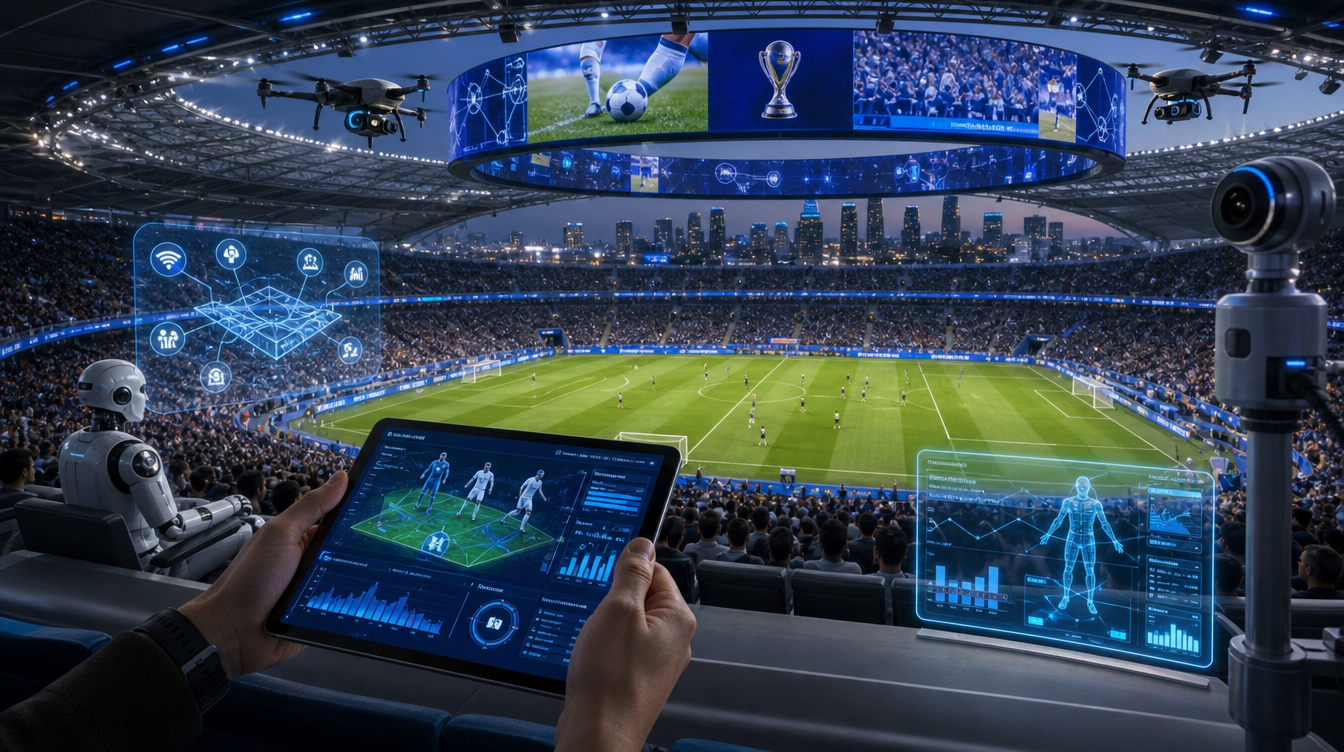
The tournament shows AI working as operational infrastructure rather than a novelty: automated decision support (offside calls), real-time data analysis (player and crowd tracking), computer vision at scale, and AI-enhanced customer experience (augmented broadcasts and stadium apps). Every one of these capabilities has a direct commercial equivalent in retail, logistics, real estate, events, and city management, and businesses that adopt them early gain a measurable service and efficiency advantage.
Why FIFA World Cup 2026 Is a Showcase for AI Innovation
Strip away the sport and look at what the systems actually do.
The semi-automated offside technology is automated decision support. Cameras track every player, the ball reports its own movement, and software flags clear offsides directly to officials, cutting decision time from minutes of video review to seconds. A human referee still makes the final call; the machine removes the drudgery and the delay. That division of labour, machines handling detection and humans handling judgement, is exactly the pattern that works in fraud detection, medical imaging, and quality control.
The player avatars are computer vision solving an identification problem. Crowded penalty areas made players hard to track, so FIFA scanned each one and built digital models that the system (and broadcasters) can use to identify and display exactly what happened. Any warehouse, port, or retail chain trying to track thousands of moving objects has the same problem in different clothes.
The fan-facing layer, stabilised referee-cam footage and point-your-phone augmented overlays, is AI applied to customer experience. It takes raw operational data the organisation already has and turns it into something customers value. Most businesses sit on similar data and never monetise it.
The lesson isn't "buy AI." It's that AI has crossed from demonstration to operations, and it did so in the most unforgiving live environment there is: a billion people watching, no second takes.
How AI Is Transforming Large Events
Behind the cameras, a tournament of this size is a logistics operation wearing a sports jersey, and AI now runs through every layer of it.
| Event function | How AI is applied | The business equivalent |
|---|---|---|
| Crowd management | Computer vision monitors density and flow, flags bottlenecks before they become dangerous | Malls, airports, attractions managing footfall |
| Security | Anomaly detection across camera networks; screening support | Facilities management, critical infrastructure |
| Ticketing | Dynamic fraud detection, demand forecasting | E-commerce, travel, entertainment platforms |
| Traffic and transport | Predictive routing around venues, coordination with city transit | Logistics fleets, delivery networks, smart parking |
| Customer experience | Multilingual chatbots, personalised apps, AR overlays | Retail, hospitality, banking service channels |
| Broadcasting | Automated cameras, real-time graphics, AI-stabilised footage | Content production, corporate communications, e-learning |
The point of the table is the third column. Not one of these applications is sport-specific. An organiser managing 80,000 people leaving a stadium in twenty minutes is solving the same maths problem as a metro operator at rush hour or a mall on the first day of the January sales. The World Cup just forces the solution to work.
What Smart Cities Can Learn
The host cities' preparations preview how urban infrastructure is starting to operate everywhere, and the concepts involved are simpler than the jargon suggests.
A digital twin is a live virtual copy of a physical place: a stadium, an airport, a district. Sensors feed it real data, so planners can test questions ("what happens if we close this gate?" "where does the crowd go if it rains?") on the model instead of on real people. Cities and venue operators used exactly this kind of modelling to plan World Cup crowd flows. The commercial version is already here: developers model buildings before construction, factories simulate production lines, and ports test berth allocations virtually.
Sensor networks are the nervous system underneath. Footfall counters, air quality monitors, smart utilities, connected traffic signals. Individually they're trivial; connected and analysed, they let a city (or a business campus, or a mall) see itself in real time.
Smart transport and public safety follow from the same data: predictive traffic management, transit capacity that flexes with demand, emergency services positioned where incidents are statistically likely rather than where they happened last.
For entrepreneurs, each layer is a market: someone sells the sensors, someone integrates them, someone builds the analytics, someone runs the control room. Smart city spending is programmatic and long-term, which makes it an unusually stable customer base for technology companies.
Smart city technologies and business use cases
| Technology | What it does | Commercial use case |
|---|---|---|
| Digital twins | Live virtual models of buildings, districts, or assets | Property development planning, facilities management, event simulation |
| Sensor networks (IoT) | Real-time monitoring of movement, utilities, environment | Footfall analytics for retail, predictive maintenance, energy management |
| Computer vision | Automated analysis of camera feeds | Safety monitoring, queue management, parking enforcement |
| Predictive transport systems | Demand forecasting and adaptive routing | Fleet optimisation, last-mile delivery, smart parking operators |
| Data platforms | Aggregating city or campus data into one view | Control-room services, dashboards for municipalities and mega-projects |
How the UAE Is Becoming a Global AI Hub
Here is where the story turns homeward, because while the World Cup demonstrates these technologies, the UAE has spent years building the environment to commercialise them.
The country appointed the world's first Minister of State for Artificial Intelligence in 2017 and runs a National AI Strategy 2031 aimed at making the UAE a global AI leader across priority sectors including transport, health, energy, and education. In the first quarter of 2026, the UAE ranked first globally in AI adoption, according to figures cited by the Ministry of Economy and Tourism, and it has held the top Arab position in the Global Innovation Index for six consecutive years, currently ranking 30th worldwide.
The institutional depth matters as much as the strategy documents. Digital Dubai has been converting government services to data-driven platforms for a decade. Abu Dhabi hosts MBZUAI, a graduate research university dedicated entirely to AI. Free zones such as Dubai Internet City, DIFC (with its innovation hub), and others have built licensing categories, visa pathways, and communities specifically for technology companies. And the national Digital Economy Strategy targets doubling the digital economy's contribution to GDP.
For a founder, the practical meaning is that the UAE isn't trying to attract AI businesses with slogans; it has assembled customers (government digitisation programmes), capital (sovereign and venture), talent pathways (golden visas for specialists), and regulation designed to say yes.
Business Opportunities Created by AI
The technologies proving themselves at the World Cup translate into concrete business categories. This is where an entrepreneur should look hardest.
| Opportunity | What the business does | Who buys it |
|---|---|---|
| AI consulting & integration | Helps ordinary companies adopt AI tools and redesign processes | SMEs, family businesses, government entities |
| Computer vision solutions | Footfall analytics, safety monitoring, quality inspection | Retail, construction, manufacturing, events |
| SaaS with AI features | Vertical software (clinics, salons, logistics) with automation built in | Sector-specific businesses across the GCC |
| Healthcare AI | Diagnostic support, patient flow, administrative automation | Hospitals, clinics, insurers |
| Logistics & smart mobility | Route optimisation, fleet analytics, warehouse automation | Delivery firms, 3PLs, ports, municipalities |
| FinTech | Fraud detection, credit scoring, personalised banking | Banks, lenders, payment platforms |
| PropTech | Building management, valuation models, digital twins | Developers, facilities managers, REITs |
| EdTech | Adaptive learning, tutoring platforms, corporate training | Schools, universities, employers |
| Cybersecurity | AI-driven threat detection and response | Every digitising organisation |
| Event & venue technology | Crowd analytics, ticketing intelligence, fan engagement | Stadiums, exhibition centres, festivals |
Two honest observations about this list. First, the deepest opportunity in the region is not building frontier AI models; it's applying proven tools to unglamorous local problems, because the Gulf has capital-rich buyers and a shortage of implementers. Second, competition is arriving quickly in every category, so the durable advantage is sector knowledge: the founder who understands clinics beats the founder who understands only code.
Why Entrepreneurs Should Consider Starting an AI Business in Dubai
The case rests on practical fundamentals rather than hype.
| Factor | What it means for an AI startup |
|---|---|
| Location | Within an eight-hour flight of most of the world's population; GCC, Africa, and South Asia as addressable markets |
| Customers | Government digitisation programmes and large corporates actively procuring AI solutions |
| Capital | Active venture ecosystem plus sovereign funds investing in technology |
| Talent | Golden visa pathways for specialists; a deep international hiring pool |
| Tax | No personal income tax; 9% corporate tax with a 0% rate available on qualifying free zone income (conditions apply) |
| Infrastructure | High cloud and connectivity standards; data centres expanding rapidly |
| Regulation | Innovation-friendly licensing, regulatory sandboxes, and dedicated tech free zones |
How A&A Associate LLC Helps Technology Businesses
Watching a market open is one thing; entering it with the right structure is another, and that's the work we do with technology founders every week. A&A Associate LLC advises startups and international companies on business setup in Dubai and company formation across the UAE, including the choice that shapes everything downstream: free zone company setup in a technology-focused zone versus mainland company formation for direct access to government and domestic customers.
Because AI startups tend to scale fast and raise capital, the back office matters early. Our corporate tax services team advises on qualifying free zone status and the conditions attached to it, while accounting and bookkeeping services and VAT registration support keep the records investor-ready from day one; where audited statements are needed, our audit services team handles them. For founders relocating teams, PRO services manage visas and government processes, and our business advisory specialists work through the questions that don't fit a form: holding structures, IP ownership, and expansion sequencing.
The founders who move smoothly are the ones who treat structure, tax, and compliance as part of the product roadmap rather than an afterthought. That's the gap we close.
Frequently Asked Questions
How is AI used during FIFA World Cup 2026?
What are digital twins?
What are smart cities?
Why is Dubai attractive for AI startups?
Can foreigners start AI companies in the UAE?
What is the UAE AI Strategy 2031?
What industries benefit most from AI right now?
How does AI improve customer experience?
Do I need to be a technical founder to start an AI business?
Free zone or mainland for a tech company?
Are there risks in the AI sector entrepreneurs should weigh?
Why work with business setup consultants?
Conclusion
The World Cup will crown a champion and move on. The technology stays. Semi-automated decision systems, computer vision at scale, digital twins, and AI-driven customer experience have now been proven in front of a billion people, which means the season of pilots is over and the season of deployment has begun.
The UAE has positioned itself deliberately for that season, with strategy, institutions, capital, and customers already in place. For entrepreneurs, the timing question isn't whether these technologies will reshape ordinary industries; the tournament settles that. It's who will do the reshaping in each market, and from where.
Building a technology business in the UAE?
The team at A&A Associate LLC works with founders at exactly this stage and would be glad to talk through your plans.
Talk to Our TeamDisclaimer: This article is for informational purposes only. Business opportunities, regulations, and AI technologies evolve rapidly. Entrepreneurs should conduct independent research and seek professional advice before making investment or business decisions.