Why Abu Dhabi Is Emerging as a Top Destination for New Businesses in 2026
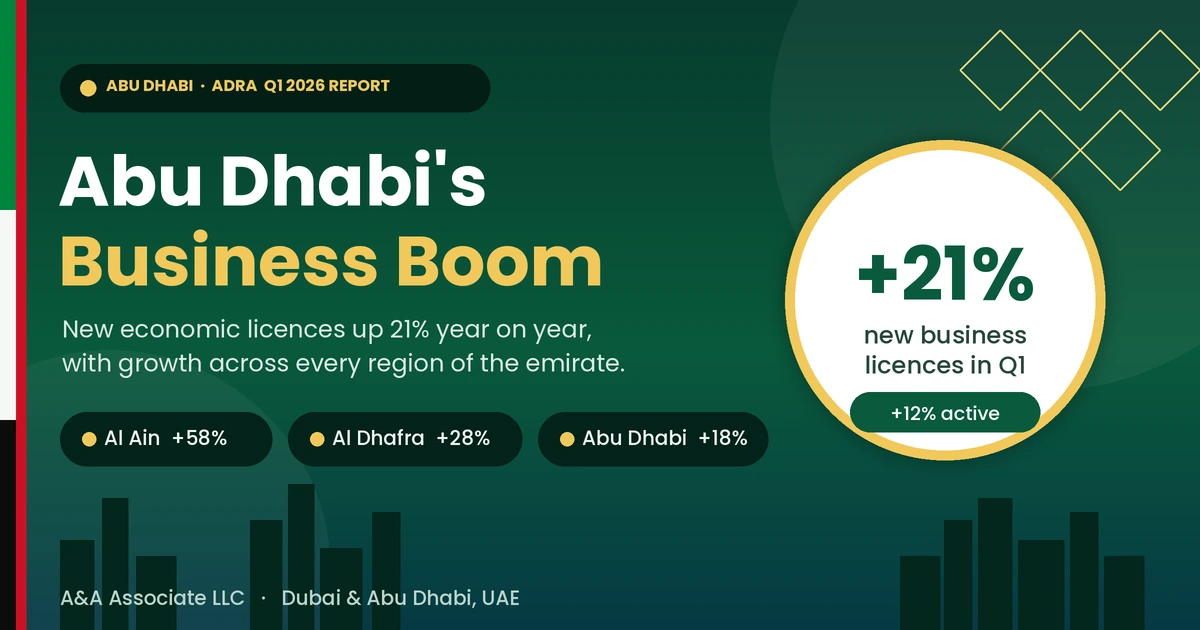
Abu Dhabi just gave entrepreneurs a number worth paying attention to. New Abu Dhabi business licences rose 21% in the first quarter of 2026 compared with the same period a year earlier, according to the Abu Dhabi Registration Authority (ADRA), the business-sector arm of the Abu Dhabi Department of Economic Development (ADDED).
That figure matters for one simple reason. New licences are people and companies voting with their money. When the count jumps by a fifth in a single quarter, while parts of the wider region face uncertainty, it tells you where investors feel confident.
This article goes past the headline. We will look at what the data shows, why it is happening, which sectors are pulling ahead, and what it means if you are weighing up business setup in the UAE. If Abu Dhabi has been on your shortlist, the Q1 numbers are a strong reason to take a closer look.
Abu Dhabi records strong business growth in Q1 2026
The first quarter of 2026 was a good one for the emirate. Here is what ADRA reported, year on year.
The growth was not limited to the capital. It spread across every region of the emirate.
"Abu Dhabi continues to demonstrate its ability to transform challenges into opportunities for growth, underpinned by the strength of the emirate's policies and legal frameworks."
H.E. Hamad Sayah Al Mazrouei — Undersecretary, Abu Dhabi Department of Economic Development (ADDED)
Why are more businesses choosing Abu Dhabi?
A 21% rise does not happen by accident. Several forces are working together.
Regulations built to help
ADRA serves as a single business registry for both mainland and free zones, eliminating duplication and streamlining the setup process.
Economic diversification
Abu Dhabi has moved its economy beyond oil into manufacturing, technology, finance, logistics, and tourism — creating room for many business types.
Strategic location
Abu Dhabi sits within easy reach of Europe, Asia, and Africa, with strong ports, airports, and road links — a daily advantage for trading companies.
Visible government support
Programmes backing SMEs, industry, and innovation give founders a softer landing. The state is an active partner, not a distant regulator.
Foreign investors are welcome
Reforms across the UAE have widened the door to full foreign ownership in many activities, removing a hurdle that once put people off.
Professional licences surge by 193% — what is driving this trend?
A few things are pushing this hard.
- Consultancy is booming. As more companies set up, they need advisers — from legal and financial to strategy and HR. New businesses create demand for the people who guide them.
- Technology and digital services are scaling fast. Software firms, app developers, data specialists, and digital marketers can launch with low overheads and serve clients anywhere.
- Independent professionals are formalising. Skilled people who once worked informally are now taking proper licences, which brings them into the regulated economy.
Growing opportunities for entrepreneurs in Abu Dhabi
So where do the openings actually sit? The Q1 data points to a few clear groups.
Startups
Room to run, especially in tech and digital services, where the cost of entry is low and the support network is growing.
SMEs
Rising local demand from more companies and residents means more customers for everything from accounting to facilities management.
Foreign Investors
Wider ownership rules and a stable dollar-pegged currency remove layers of risk for cross-border investors.
Service Businesses
Consultancies, agencies, and specialist firms are in demand from the very companies setting up around them.
E-commerce
Online shopping habits continue deepening across the UAE. Reach a connected, high-spending customer base with a commercial or Tajer licence.
Industrial growth and Abu Dhabi's economic vision
The story is not only about offices and laptops. Industry is moving too. In Q1 2026, the number of industrial licences moving into the production phase rose 3%, with 34 new industrial facilities entering full operation in the first three months of the year. Those are factories switching on, not just plans on paper.
This ties directly to the Abu Dhabi Industrial Strategy (ADIS), which aims to strengthen supply chains and lift local production capacity. For investors, that opens specific doors:
- Manufacturing — from food processing to building materials and advanced products.
- Supply chain and logistics — businesses that move goods to and from new industrial plants.
- Industrial services — maintenance, packaging, and equipment supply for the growing factory base.
Rise of freelance and home-based businesses
Some of the most eye-catching growth came from the smallest operators.
A 261% jump in freelance licences is a genuine shift in how people work. The licences are affordable and quick, so the risk of trying is low. Today's solo licence is often tomorrow's small company.
What this means for foreign investors
If you are based outside the UAE, the Q1 figures carry a specific message.
- The market is opening, not closing. While other places tightened or wavered, Abu Dhabi added new businesses at pace. That is the kind of climate where early movers do well.
- The investment environment is stable. A dollar-pegged currency, clear regulation through ADRA, and an active government reduce the surprises that put off cross-border investors.
- Reforms keep tilting in your favour. Wider foreign ownership and streamlined licensing lower the practical barriers to entry.
- The growth looks structural, not a blip. Diversification, industrial strategy, and a deepening services sector are long-term drivers, not one-quarter wonders.
Key sectors showing strong growth in Abu Dhabi
Different sectors offer different routes in. The table below sketches where the opportunity sits and the typical licence route.
| Sector | Why It Is Growing | Typical Licence |
|---|---|---|
| Professional Services | 193% jump in professional licences; rising demand for advisers | Professional |
| Technology | Innovation focus; low-cost digital startups scaling fast | Professional / Commercial |
| Manufacturing | Industrial Strategy backing new production capacity | Industrial |
| Consulting | New companies need legal, financial, and strategy support | Professional |
| E-commerce | Deepening online shopping across the UAE | Commercial / Tajer |
| Logistics | Strategic location plus new industrial supply chains | Commercial / Industrial |
| Healthcare | Population growth and ongoing investment in services | Professional / Commercial |
| Education | Demand from a young, growing resident population | Professional / Commercial |
Why 2026 could be a strong year for business setup in Abu Dhabi
A single quarter is not a trend on its own. But the Q1 numbers sit on top of years of steady building, which is what makes them convincing. Three points stand out.
The Breadth
Growth showed up across regions, across licence types, and across both services and industry. Narrow booms are fragile. Broad ones tend to last.
The Context
These gains came despite regional uncertainty. Demand that holds up in a tough climate is usually demand you can trust.
The Policy Direction
With ADIS driving industry and ADRA simplifying setup, the supporting framework is pointing the same way as the numbers.
How to start a business in Abu Dhabi
If the case has won you over, here is the path in plain steps.
Choose your business activity
This decides your licence type and any approvals you need. Be specific — vague activities cause delays.
Select a legal structure
Mainland, free zone, sole establishment, or LLC. Each suits different goals and ownership plans.
Reserve your trade name
Pick a name that meets UAE naming rules and reserve it through the registry before someone else does.
Obtain initial approvals
Some activities need clearance from specific authorities before you proceed to the licence stage.
Apply for your licence
Submit documents to ADRA and pay the fees to receive your commercial, professional, or industrial licence.
Open a business bank account
With your licence in hand, set up banking so you can trade, pay, and get paid from day one.
How A&A Associate LLC can help
A&A Associate LLC is a Dubai-based advisory firm working with entrepreneurs and companies across the UAE. We handle the practical side of setting up and running a compliant business — so you can focus on the work itself. Our support covers the full journey: