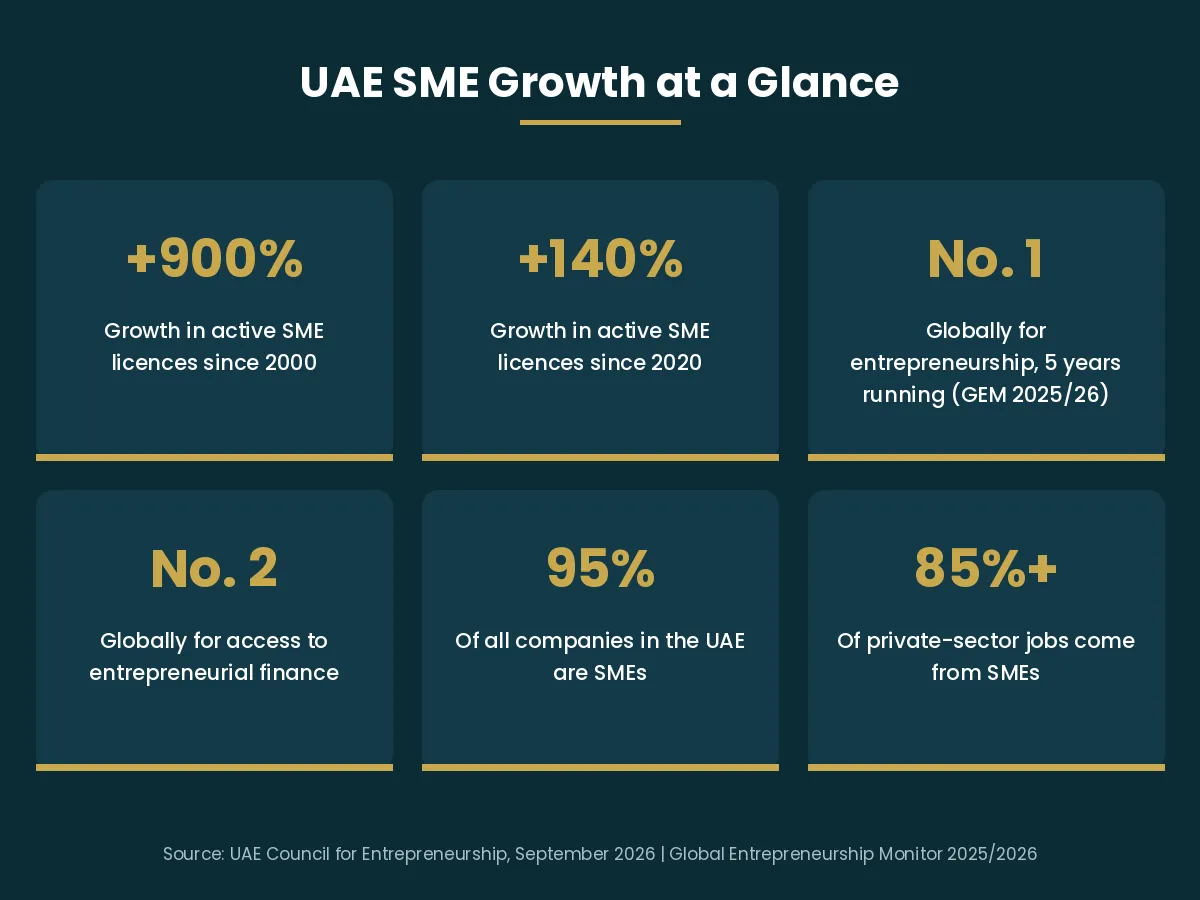
Two numbers, one story. The number of active SME licences in the UAE has grown by more than 900% since 2000, and by more than 140% just since 2020. The first figure describes a transformation; the second says the transformation is speeding up, not slowing down.
Those figures were reviewed this month at a meeting of the UAE Council for Entrepreneurship, chaired by Abdulla bin Touq Al Marri, Minister of Economy and Tourism, alongside a third data point that gives them context: the UAE has just been ranked first globally for entrepreneurship for the fifth consecutive year in the Global Entrepreneurship Monitor 2025/2026 report.
If you’re an entrepreneur, a founder weighing markets, or an investor watching where small businesses actually thrive, this is worth ten minutes of your attention. Not because the numbers are big (big numbers are cheap), but because of what sits underneath them: two decades of deliberate ecosystem building, and a set of programmes that tells you where UAE small business growth is heading next.
UAE Small-Business Licences Have Grown More Than 900%
Start with the honest caveat: a licence is not a business, and certainly not a successful one. Some licences belong to side projects, some to ventures that never traded, some to companies that closed the following year. What licence numbers measure is participation, or how many people decided the UAE was worth formally committing to as a place to try.
Read that way, a 900% rise over two decades is remarkable. In 2000, the UAE economy was still overwhelmingly an oil and trade story, and the small business layer was thin. The years since brought free zone expansion, full foreign ownership on the mainland, long-term residence visas, digitised licensing, and an economy that deliberately diversified into logistics, technology, tourism, finance, and professional services. Each of those shifts lowered a barrier, and the licence curve is the cumulative result.
The 2020 comparison matters for a different reason. A 140% increase in five and a bit years means most of this growth is recent. It didn’t taper off once the easy gains were made. The pandemic period, which thinned out small business populations in much of the world, marks the start of the UAE’s steepest climb. That timing is not an accident; it coincides with the wave of reforms around ownership, visas, and remote work that made the country dramatically easier to commit to.
So no, 900% doesn’t mean every licence is a thriving company. It means the top of the funnel has widened tenfold. Ecosystems are volume games, and the UAE has built volume.
UAE Ranked No. 1 Globally for Entrepreneurship Again
The Global Entrepreneurship Monitor is the closest thing the field has to a standard benchmark, and its 2025/2026 report ranks the UAE first in the world for entrepreneurship conditions for the fifth year running. The report covers 53 economies, and the UAE also placed second globally for entrepreneurial finance and for ease of access to entrepreneurial finance.
What does a ranking like that actually measure? GEM scores framework conditions: how supportive government policy is, how heavy taxes and bureaucracy feel, whether entrepreneurial education and programmes exist, how easy market entry is, and whether finance is reachable. The UAE ranked first among high-income economies on eight of those indicators, including government policy, entrepreneurial programmes, market dynamics, and ease of entry.
The finance ranking deserves its own sentence. Access to money is where most entrepreneurship ecosystems quietly fail; a country can be easy to register in and still be a desert for funding. Second place globally on both finance measures suggests the UAE’s venture capital growth, bank lending programmes, and government funds are reaching founders, not just existing on paper.
One ranking, even five in a row, guarantees nothing for your specific venture. Conditions are the weather, not the harvest. But if you’re choosing where to build, five consecutive years at the top is a pattern, not a fluke, and patterns are what location decisions should rest on.
Why SMEs Matter to the UAE Economy
The strategic logic behind all this support becomes obvious from two figures the Council reviewed: SMEs account for roughly 95% of companies operating in the UAE and contribute more than 85% of private-sector employment.
Sit with that second number. For every large corporate employer in the UAE’s private sector, the overwhelming majority of jobs come from small and medium enterprises. That makes the UAE SME sector not a nice-to-have but the employment engine of the economy, and it explains why SME policy sits at ministerial level rather than being delegated downward.
SMEs also carry the diversification agenda. A country reducing its reliance on oil needs thousands of experiments in new sectors, and small businesses run those experiments faster and cheaper than anyone else. They adopt new technology earlier, serve niches large firms ignore, and occasionally grow into the anchor companies of entirely new industries. Every economy says it values small business; the UAE’s numbers show it depends on them.
For entrepreneurs, the practical implication is alignment. When you’re 95% of the companies and 85% of the jobs, government incentives tend to run in your favour, because your success is the national strategy.
Government Support Is Expanding the UAE Entrepreneurship Ecosystem
The clearest recent example is “The Emirates: The Startup Capital of the World”, the national campaign launched by Sheikh Mohammed bin Rashid Al Maktoum in September 2025, whose first-year results the Council reviewed:
- More than 400 Emirati men and women trained and qualified through the campaign’s programmes
- 214 citizens supported through the Riyada programme, which recorded a 97% satisfaction rate
- 41 government initiatives launched across nine areas, implemented with 10 partner entities in five emirates
- Dh202 million in government procurement generated through the campaign
- A further 405 businesses registered in the suppliers’ registry
The procurement figure is the one to flag for founders. Dh202 million is not grant money or soft support; it’s revenue, contracts signed between government entities and small businesses. Adding 405 companies to the suppliers’ registry extends that pipeline. Government demand is one of the most reliable early customers a small business can have, and the campaign has deliberately turned procurement into an SME support tool.
Beyond the numbers, the campaign worked across unusually varied ground: incubation support, tax-agent registration, project-management licensing, the Emirati Families Programme, and student projects. That spread tells you the ambition isn’t just startups in the venture-capital sense. It’s entrepreneurial participation across society, from family businesses to students to licensed professionals.
The UAE Moves Towards a National Entrepreneurship Strategy
Perhaps the most consequential item on the Council’s agenda was also the least flashy: progress on a deeper national entrepreneurship strategy.
The proposed strategy focuses on improving the competitiveness of the entrepreneurship ecosystem, supporting the growth and long-term sustainability of SMEs, and creating a more flexible business environment, with closer coordination between federal and local authorities and proper measurement of what government programmes actually achieve.
Why should a founder care about strategy documents? Coordination, mostly. The UAE is seven emirates with their own licensing authorities, plus dozens of free zones. That variety is a strength for choice but can mean navigating different rules in different places. A national strategy that aligns federal and local efforts points towards a more consistent experience wherever in the country you operate. And the emphasis on measuring impact suggests programmes that don’t work will be fixed or dropped, which is how ecosystems improve rather than just expand.
OECD Cooperation Could Strengthen UAE SME Policies
The Council also reviewed policy recommendations being developed with the OECD, the international body whose day job is comparing what works across the world’s developed economies. The recommendations centre on four areas, and each translates into something concrete for business owners:
- Access to finance. More, and more varied, routes to funding, from bank lending to venture capital to government-backed schemes.
- Innovation. Support for SMEs adopting new technology and developing new products, not just for glamorous startups.
- Internationalisation. Helping UAE-based small businesses sell abroad, which matters in a country where the domestic market alone rarely completes a growth story.
- Measurement. Better data on what SMEs need and whether programmes deliver, which sounds dry but is what separates effective support systems from expensive ones.
Alongside the four areas sits work on the legislative and regulatory environment itself. In plain terms: the UAE is benchmarking its small business rules against global best practice and inviting outside scrutiny of the results. Countries confident in their ecosystem do this; countries running on marketing don’t.
Mobile Accelerators Could Bring Support to More Entrepreneurs
One initiative reviewed at the meeting deserves attention precisely because it isn’t aimed at Dubai’s startup districts. The “Mobile Accelerators in Villages” initiative takes business support to entrepreneurs in villages and other targeted areas, rather than expecting them to come to it.
The support on the table covers the practical bottlenecks that stall small ventures: simplified licensing procedures, access to business locations, financing, incubation programmes, and connections to markets and sales channels.
It’s easy to overlook programmes like this, but they say something about how the ecosystem thinks. Entrepreneurial talent is distributed everywhere; opportunity usually isn’t. Reducing the practical barriers of distance, paperwork, and market access is often worth more to a small business than any amount of inspiration, and an ecosystem that works on its edges rather than only its centre tends to be one that lasts.
What This Means for Entrepreneurs Looking at the UAE
Put the pieces together and a picture forms. The UAE is not simply trying to attract entrepreneurs, which plenty of countries now do with a visa and a landing page. It’s building the full arc of what a business needs after arrival: launch support, access to funding (where it now ranks second globally), innovation programmes, routes to customers including Dh202 million of government procurement, internationalisation help for going global, and a policy machine that measures itself against OECD benchmarks.
The 900% licence growth is the trailing indicator of that machine working. The GEM ranking is the external audit of it. And the national strategy, OECD work, and village accelerators are the forward commitments, signalling that the next five years of entrepreneurship in the UAE are being planned as deliberately as the last twenty were.
The honest framing is this: the UAE offers unusually good conditions, not guaranteed outcomes. Your business still has to work. What the ecosystem removes is the extra friction that kills viable businesses in less organised markets.
How Businesses Can Prepare for Growth in the UAE
Favourable conditions reward the prepared, so if the UAE is on your shortlist, the groundwork looks like this:
- Choose your structure deliberately. Mainland and free zone suit different models, and the right answer depends on where your customers are.
- Understand licensing requirements for your specific activity before you commit, since activities carry different approvals and obligations.
- Build a realistic financial plan that covers the first slow year, not just the setup phase.
- Get clear on tax and accounting obligations early. Corporate tax registration, bookkeeping, and (where relevant) VAT are now part of running even a small UAE business.
- Evaluate the market opportunity honestly, including competition in your niche, not just the macro numbers above.
- Plan your banking, including the documentation banks expect from new companies.
- Set up compliance processes from day one rather than retrofitting them under pressure.
- Map the funding landscape relevant to your stage, from banks to government programmes to venture capital.
- Leave room to expand, because structures chosen for launch sometimes constrain growth later.
Most of these decisions are cheap to get right at the start and expensive to correct afterwards. If you’d rather work through them with people who do it daily, our business setup in Dubai team advises founders on exactly these choices, from structure and licensing through to corporate tax and accounting obligations.
Frequently Asked Questions
How much has the UAE SME sector grown?
The number of active SME licences in the UAE has risen by more than 900% compared with 2000 and by more than 140% compared with 2020, according to figures reviewed by the UAE Council for Entrepreneurship in September 2026. Licence numbers indicate entrepreneurial participation rather than guaranteed success, but the scale and recency of the growth point to an ecosystem that is still accelerating.
Why is the UAE ranked first globally for entrepreneurship?
The Global Entrepreneurship Monitor 2025/2026 report ranked the UAE first worldwide for the fifth consecutive year, based on framework conditions such as government policy, entrepreneurial programmes, ease of market entry, infrastructure, and education. The UAE also ranked second globally for entrepreneurial finance and ease of access to finance.
How important are SMEs to the UAE economy?
Very. SMEs account for approximately 95% of companies operating in the UAE and contribute more than 85% of private-sector employment. They also carry much of the country’s economic diversification, innovation, and job creation, which is why SME support sits at the centre of national economic policy.
What government support is available for UAE entrepreneurs?
Recent examples include “The Emirates: The Startup Capital of the World” campaign, which trained more than 400 Emiratis, supported 214 citizens through the Riyada programme, launched 41 government initiatives, and generated Dh202 million in government procurement for small businesses. Support spans incubation, licensing, funding access, and supplier-registry participation.
What is the UAE’s national entrepreneurship strategy?
A strategy under development that aims to improve SME competitiveness, support business growth and sustainability, create a more flexible business environment, and coordinate federal and local efforts. It is being informed by policy recommendations developed with the OECD across access to finance, innovation, internationalisation, and measurement.
How does access to finance support UAE startups?
The UAE ranks second globally for entrepreneurial finance and ease of access to it, per GEM 2025/2026. In practice that means founders can draw on a comparatively broad mix of bank lending, venture capital, and government-backed funding programmes, with further improvements identified as a priority in the OECD policy work.
What should entrepreneurs consider before launching a business in the UAE?
The structural decisions: business activity, mainland versus free zone, licensing requirements, a realistic financial plan, tax and accounting obligations, banking readiness, and compliance processes. Favourable ecosystem conditions improve the odds but don’t replace preparation, and early structural choices are far cheaper to get right than to correct.
The Bottom Line
Twenty years ago, choosing the UAE for a small business was a bet on potential. The 900% licence growth, five straight years atop the global entrepreneurship rankings, and a policy pipeline running from OECD benchmarks to village accelerators say that bet has been settled. What remains is the individual one: whether your business, properly structured and prepared, can make the most of conditions this deliberately built.
If you’re considering entering or expanding in the UAE, A&A Associate LLC’s business setup and advisory team can help you work through the decisions that matter before you commit. A conversation costs nothing and tends to save a great deal.
Figures in this article are drawn from the UAE Council for Entrepreneurship meeting reported in September 2026, the Ministry of Economy and Tourism, and the Global Entrepreneurship Monitor 2025/2026 report. Verify current programme details through official UAE government channels.