The UAE Ministry of Finance has answered a question multinational groups have been asking since the country’s Top-up Tax framework arrived: which of our UAE entities actually has to file the paperwork?
Ministerial Decision No. 133 of 2026 sets out exactly which entities must file the UAE Pillar Two Information Return with the Federal Tax Authority, and how that filing can be organised. The rules apply to fiscal years beginning on or after 1 January 2025.
One clarification belongs right at the top, because it’s where most of the confusion sits. This decision does not introduce a new tax. The UAE’s Top-up Tax on large multinational enterprises already exists, established by Cabinet Decision No. 142 of 2024. What the new decision does is narrower and, for finance teams, more practical: it tells you who carries the reporting responsibility under that existing framework. If a colleague forwarded you a headline suggesting the UAE just created another tax, that’s the misreading to correct first.
If your group has UAE subsidiaries, joint ventures, or a structure complicated enough that nobody is entirely sure which entity does what, this article walks through the rules in plain language.
What Is the UAE Pillar Two Information Return?
Some background before the filing rules make sense.
Pillar Two is an international tax framework developed by the OECD/G20 Inclusive Framework, agreed by well over a hundred jurisdictions. Its purpose is blunt: to make sure the world’s largest multinational groups pay a minimum level of tax somewhere, regardless of how their profits are spread across countries. The technical rulebook behind it is called the GloBE Rules, short for Global Anti-Base Erosion.
For a system like that to work, tax authorities need detailed information: which entities belong to a group, where they sit, what they earn, and what effective tax rate they pay in each jurisdiction. The Pillar Two Information Return is that reporting document. It’s how a multinational group tells the tax authority what it needs to know to apply the rules.
The UAE joined this system in stages. Cabinet Decision No. 142 of 2024 introduced the UAE’s Top-up Tax for multinational enterprises, effective for financial years starting on or after 1 January 2025. Ministerial Decision No. 133 of 2026 now completes a practical piece of that picture by specifying who files the information return with the Federal Tax Authority.
Worth stressing: none of this applies to most UAE businesses. Pillar Two targets large multinational enterprise groups, broadly those with annual consolidated global revenue of at least €750 million in at least two of the four preceding fiscal years. Your typical UAE SME, or even a sizeable domestic company, is outside this framework entirely and continues to deal only with ordinary UAE Corporate Tax.
What Did Ministerial Decision No. 133 of 2026 Change?
Think of the UAE’s Pillar Two implementation as two layers.
The first layer is the tax itself. Cabinet Decision No. 142 of 2024 established the Top-up Tax, the mechanism through which the UAE ensures in-scope multinational groups reach the minimum effective tax level on their UAE operations. That layer hasn’t changed.
The second layer is reporting, and this is where the new decision operates. Until now, groups knew a Pillar Two Information Return would be required but had less clarity on which UAE entities carried the obligation. A group with one Dubai subsidiary faced a simple question; a group with six UAE entities, two joint ventures, and a holding structure spanning three free zones faced a genuinely uncertain one.
Ministerial Decision No. 133 of 2026 resolves that by naming the categories of entities that must file, and by confirming a mechanism for centralising the filing. The Ministry has framed the decision as supporting consistent implementation of the GloBE Rules and giving multinational enterprises more certainty over their reporting obligations, which is a fair description of what it does. It’s a compliance-clarity decision, and describing it as a new corporate tax would be wrong.
Which UAE Entities Must File the Pillar Two Information Return?
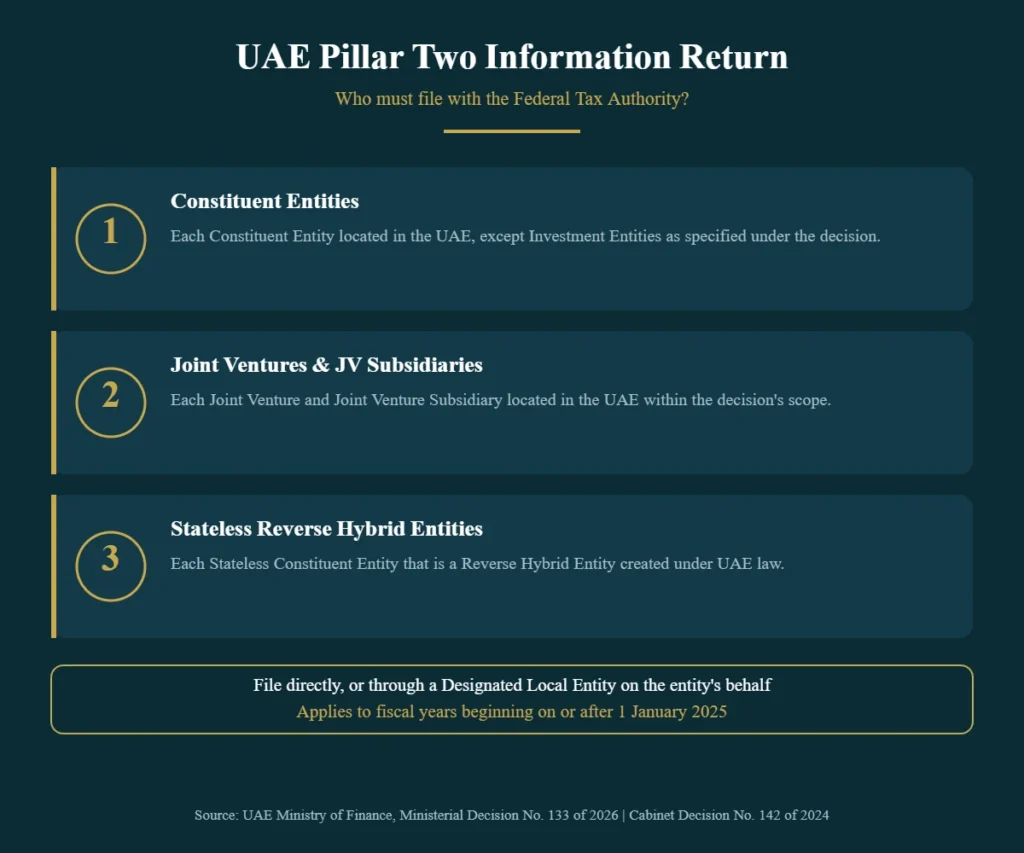
The decision names three categories. This is the section to read slowly if your group operates here.
1. Constituent Entities located in the UAE (except Investment Entities)
A Constituent Entity, in plain language, is an entity that forms part of a multinational group covered by the Pillar Two framework: subsidiaries, branches, and other group members whose results are consolidated into the group’s financial statements. If your company is the UAE arm of an in-scope multinational, it is very likely a Constituent Entity.
Under the decision, each Constituent Entity located in the UAE has a filing responsibility, with one carve-out: Investment Entities, as specified under the decision, are excluded from this particular requirement.
Notice the word “each”. The obligation attaches to every UAE Constituent Entity, not just the biggest or the first-registered one. A group with five UAE entities has five entities carrying the obligation, even if the filing itself ends up centralised.
2. Joint Ventures and Joint Venture Subsidiaries located in the UAE
The requirement also applies to each Joint Venture and Joint Venture Subsidiary located in the UAE that falls within the decision’s scope. This matters because JVs often sit awkwardly in group compliance processes; they’re partly owned, sometimes separately managed, and easy to overlook when head office draws up its filing map. The UAE rules put them squarely inside the reporting perimeter.
3. Certain Stateless Constituent Entities
The third category is the most technical: a Stateless Constituent Entity that is a Reverse Hybrid Entity created under UAE law must also file. Without turning this into a treatise, a reverse hybrid is an entity treated as transparent (looked through) where it was created but as a taxable entity by the jurisdiction of its owners, which can leave it “stateless” for Pillar Two purposes. These structures exist for legitimate reasons, but they’re exactly the kind of arrangement the GloBE Rules track carefully.
If you suspect your structure includes anything in this category, or you’re not sure, this is a determination to make with professional advice rather than by analogy. The definitions are precise and the classification depends on the specific facts.
Which Entities Are Excluded?
Investment Entities are excluded from the filing requirement that applies to UAE Constituent Entities under this decision.
Two cautions before anyone relaxes. First, “Investment Entity” is a defined term under the Pillar Two rules, not a description. An entity that holds investments is not automatically an Investment Entity in the technical sense; the classification has conditions, and assuming it without checking is one of the easier mistakes to make in this area.
Second, exclusion from this specific filing obligation is not a general exemption. An Investment Entity may still have other Pillar Two responsibilities, and its results still matter to the group’s overall GloBE position. The exclusion tells you who files this return; it doesn’t remove an entity from the framework.
Can a UAE Entity File the Return on Behalf of Other Group Entities?
Yes, and for groups with multiple UAE entities this is probably the most operationally useful part of the decision.
A covered Constituent Entity, Joint Venture, or JV Subsidiary has two routes: file the Pillar Two Information Return directly, or have a Designated Local Entity submit the return on its behalf.
The Designated Local Entity mechanism means a group can centralise its UAE Pillar Two filing through one entity rather than having every covered company handle its own submission. For a group with, say, seven UAE entities, that’s the difference between seven parallel filing processes and one coordinated exercise, provided the underlying information from each entity still gets collected properly.
A note of discipline, though: centralising the mechanics of filing is not the same as transferring the underlying responsibility. Each covered entity remains within the reporting framework, and groups using a Designated Local Entity should treat it as a coordination tool, with clear internal accountability for the accuracy and completeness of what gets filed. Where the precise legal effect matters to you, that’s a question for the legislation and your advisers.
When Do the UAE Pillar Two Rules Apply?
The reporting rules apply to fiscal years beginning on or after 1 January 2025.
Don’t let the decision’s 2026 issue date confuse the timeline. The decision was issued in 2026, but it governs reporting for fiscal periods that began in 2025. A group with a January to December financial year is already inside its first covered fiscal year’s aftermath; a group with a fiscal year that began mid-2025 is inside its first covered year now.
On deadlines: we’ve deliberately not quoted a filing date here. The applicable deadline depends on the relevant fiscal year and the requirements set by the Federal Tax Authority, and deadlines are exactly the kind of detail to take from official FTA and Ministry of Finance sources rather than secondary summaries, this one included. The practical takeaway is simpler: the covered periods have already started, so preparation is a current task, not a future one.
How Does Pillar Two Fit Into the UAE Corporate Tax Framework?
A quick orientation, because these layers get conflated constantly:
UAE Corporate Tax → the general regime that applies to businesses in the UAE, with its own rates, registration, and filing requirements. Most UAE companies live here and only here.
→ Pillar Two → an additional international framework that applies only to large multinational enterprise groups meeting the revenue threshold.
→ Top-up Tax → the mechanism (under Cabinet Decision No. 142 of 2024) through which the UAE ensures in-scope groups reach the minimum effective tax level on UAE profits.
→ Pillar Two Information Return → the reporting document that provides the FTA with the information needed to apply those rules, now with clarified filing responsibility under Ministerial Decision No. 133 of 2026.
Each layer sits on the one before it, and each applies to a progressively narrower set of businesses. Pillar Two is not a general tax on UAE companies, and the information return is not part of ordinary Corporate Tax filing. They are separate obligations, and in-scope groups deal with both.
What Is the Global Minimum Tax?
The idea behind all of this machinery is easy to state. For decades, large multinationals could arrange their affairs so that significant profits landed in jurisdictions where they were taxed lightly or not at all. The global minimum tax is the coordinated response: participating jurisdictions agreed that the largest groups should face a minimum effective tax rate, generally 15%, in every jurisdiction where they operate.
The design is what makes it work. If a group’s effective rate in some jurisdiction falls below the minimum, another jurisdiction in the chain can collect a top-up amount to bring it to the floor. That removes most of the benefit of shifting profits to low-tax locations, because the tax gets collected somewhere regardless.
The UAE’s Top-up Tax framework is its participation in this system. By collecting any top-up amount on UAE operations domestically, the UAE keeps that revenue rather than leaving it for another jurisdiction’s rules to capture, while giving in-scope groups a clear domestic mechanism.
To repeat the point that saves the most misunderstanding: this 15% concept applies to large multinational groups within the Pillar Two framework. It does not mean every UAE company now faces a 15% rate. The UAE’s standard Corporate Tax regime continues to operate on its own terms for everyone else.
What Does the New Reporting Rule Mean for Multinational Groups in the UAE?
For in-scope groups, the decision converts an abstract obligation into a concrete to-do list. The work falls into a few streams.
Entity mapping comes first. A group needs a complete picture of its UAE presence: every subsidiary, branch, joint venture, and JV subsidiary, and an honest classification of each against the Pillar Two definitions. This sounds administrative until you try it across a structure that grew by acquisition; entity lists have a way of being less complete than everyone assumed.
Classification follows. Which entities are Constituent Entities? Do any qualify as Investment Entities under the actual definitions? Is there anything in the structure that could be a Reverse Hybrid? These are determinations with consequences, and the harder calls justify professional review.
Then the filing decision: will each entity file directly, or will the group appoint a Designated Local Entity to centralise the submission? For multi-entity groups, centralising is usually attractive, but it requires internal plumbing, since the designated filer needs timely, accurate information from every covered entity.
Finally, the data itself. Pillar Two reporting draws on financial and tax information that often lives in different systems, entities, and countries. Groups that start assembling it early, and document how they did, will have a much calmer filing season than groups that start when the deadline appears. And because implementation is still maturing, someone in the group should own the job of monitoring FTA and Ministry of Finance guidance as it develops.
Common Mistakes Businesses Should Avoid
- Treating the decision as a new tax. It isn’t; it clarifies reporting responsibility under the existing Top-up Tax framework.
- Assuming only the parent or main UAE company needs to report, when the obligation attaches to each covered UAE entity.
- Forgetting joint ventures. UAE JVs and JV Subsidiaries are inside the reporting perimeter.
- Missing entities entirely, because the group’s UAE entity list was out of date.
- Assuming Investment Entity treatment from the entity’s name or activity rather than the actual definitions.
- Discovering late that required information sits in another entity, another department, or another country.
- Leaving data collection until the filing period.
- Confusing this return with ordinary UAE Corporate Tax filing; they are separate obligations with separate rules.
- Relying on news summaries instead of the legislation and official FTA/MoF guidance for decisions that matter.
How Businesses Can Prepare for UAE Pillar Two Reporting
- Confirm scope. Establish whether the group falls within the Pillar Two framework at all, starting with the revenue threshold.
- Map the UAE footprint. List every UAE entity, joint venture, and JV subsidiary, with ownership and consolidation details.
- Classify each entity. Determine which are Constituent Entities, whether any meet the Investment Entity definitions, and whether anything could be a Reverse Hybrid.
- Decide the filing route. Choose between direct filing by each entity and appointing a Designated Local Entity, and document the choice.
- Assemble the data. Identify the financial and tax information the return requires and where it currently lives.
- Assign responsibility. Make one team or role accountable for the return internally, with clear inputs from each entity.
- Watch for guidance. Track FTA and Ministry of Finance publications for procedures and deadlines.
- Take advice where the structure is complex. Classification questions, hybrids, JV arrangements, and multi-jurisdiction coordination are where professional input earns its fee.
Groups with several UAE entities, joint ventures, cross-border operations, or structures that have grown untidily over the years tend to need support on exactly these points, from entity classification through to coordinating the reporting itself. That work sits alongside the group’s wider UAE corporate tax compliance, and the underlying numbers only hold up if the accounting and audit foundations are solid. A&A Associate LLC’s tax and advisory team works with multinational and multi-entity groups on precisely this kind of compliance mapping.
Frequently Asked Questions
What is the UAE Pillar Two Information Return?
It’s the reporting document that in-scope multinational groups file with the Federal Tax Authority under the UAE’s Pillar Two framework. It provides the information needed to apply the GloBE Rules and the UAE’s Top-up Tax to the group’s UAE entities.
Who must file the Pillar Two Information Return in the UAE?
Under Ministerial Decision No. 133 of 2026: each Constituent Entity located in the UAE (except Investment Entities as specified), each UAE-located Joint Venture and Joint Venture Subsidiary, and each Stateless Constituent Entity that is a Reverse Hybrid Entity created under UAE law.
Does Ministerial Decision No. 133 of 2026 introduce a new tax?
No. The Top-up Tax was established by Cabinet Decision No. 142 of 2024. The new decision clarifies which entities are responsible for filing the information return under that existing framework.
What is the UAE Top-up Tax?
The mechanism through which the UAE ensures that in-scope multinational groups reach the global minimum effective tax level on their UAE operations, as part of the OECD/G20 Pillar Two system. It applies to large multinational enterprise groups, not to UAE businesses generally.
Do UAE Joint Ventures need to file a Pillar Two Information Return?
Yes. Each Joint Venture and Joint Venture Subsidiary located in the UAE that falls within the decision’s scope carries a filing requirement, either directly or through a Designated Local Entity.
Can a Designated Local Entity file the return for other UAE entities?
Yes. A covered entity can file directly or have a Designated Local Entity submit the return on its behalf, which lets groups centralise their UAE Pillar Two filing. Each covered entity should still ensure the information reported for it is accurate and complete.
When do the UAE Pillar Two reporting rules apply?
To fiscal years beginning on or after 1 January 2025. Specific filing deadlines depend on the relevant fiscal year and official FTA requirements, so confirm dates from FTA and Ministry of Finance sources.
Does Pillar Two apply to every UAE company?
No. It targets large multinational enterprise groups, broadly those with consolidated global revenue of at least €750 million in at least two of the four preceding fiscal years. Companies outside that scope continue to deal only with the UAE’s standard Corporate Tax regime.
The Bottom Line
Ministerial Decision No. 133 of 2026 does one job, and does it clearly: it tells multinational groups which of their UAE entities must file the Pillar Two Information Return, and confirms that the filing can be centralised through a Designated Local Entity. It does not create a new Top-up Tax; that framework has existed since Cabinet Decision No. 142 of 2024.
Because the rules cover fiscal years that began in 2025, the sensible time to map entities, settle classifications, and organise data collection is now, while it’s still preparation rather than firefighting. Groups with multiple UAE entities, joint ventures, or complex structures should give the classification questions particular care.
If your group needs support working through its UAE Pillar Two reporting position, or its wider corporate tax, accounting, and compliance obligations, A&A Associate LLC’s tax and advisory team can help you map your entities and responsibilities before the deadlines make it urgent.
Disclaimer: This article is for general informational purposes only and does not constitute legal, tax or financial advice. Businesses should review the applicable legislation and official guidance and obtain professional advice based on their specific circumstances.